Furnace Replacement Cost in Chicago: 2026 Prices, Permits and Rebates

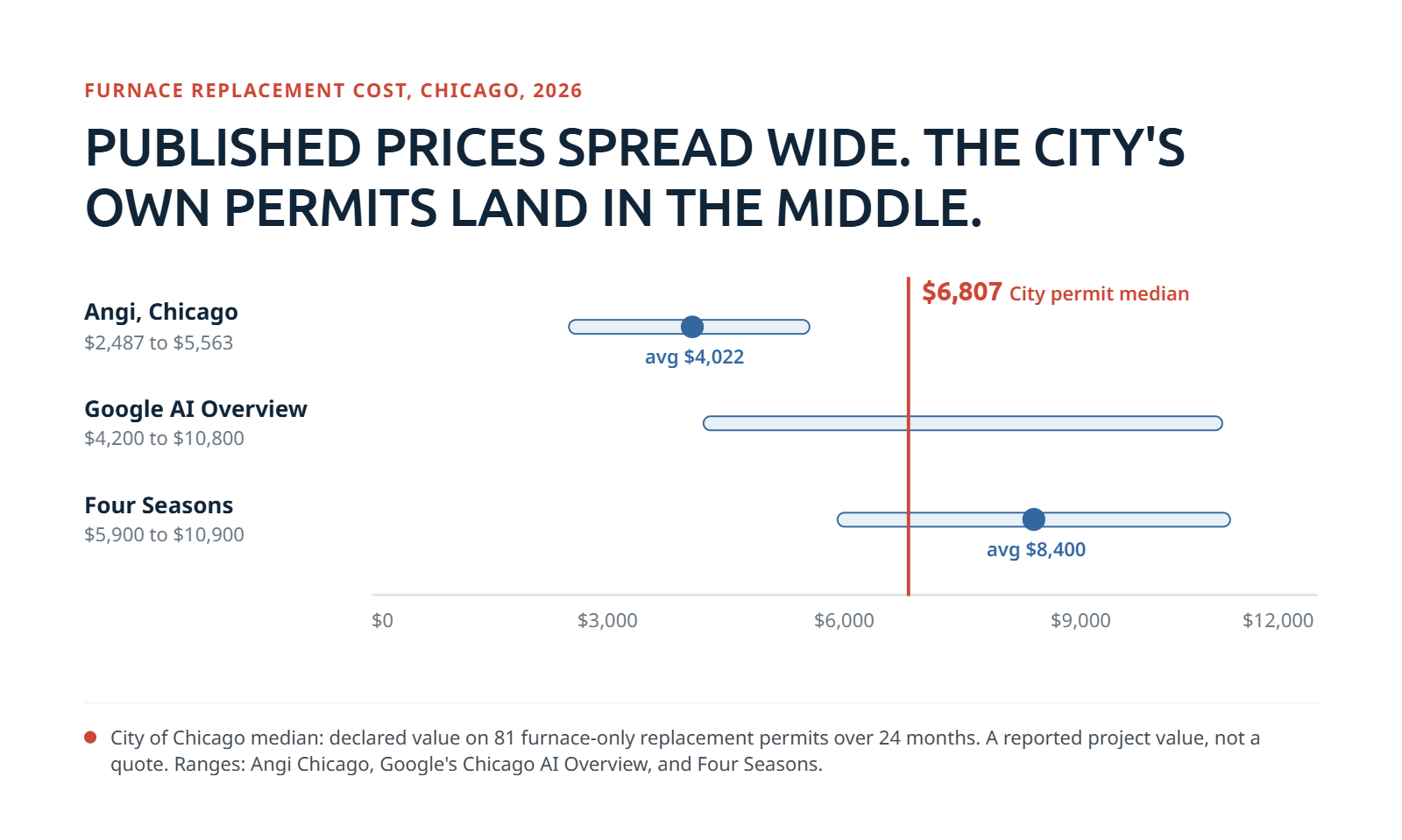
The furnace replacement cost question usually reaches me at a kitchen table in a Logan Square two-flat, printed on someone else’s quote. The homeowner points at the total and asks one thing: is this fair? Published Chicago averages disagree, from Angi’s $4,022 [8] to Four Seasons’ $8,400 [7], because they count different jobs. The City of Chicago’s own permit records put the median project value at $6,807 [3].
Before you read further, you should know who is talking. I own City & Suburban Heating & Cooling, a Chicago company that repairs and installs furnaces, so I have a stake in your decision. Every figure below links to its source so you can check me.
Q1: How much does a furnace replacement cost in Chicago in 2026?
Published Chicago figures for an installed gas furnace range from Angi’s $2,487 to $5,563 [8] to Four Seasons’ $5,900 to $10,900 [7]. A 95% furnace costs more than an 80% furnace, mainly for the venting. AFUE (annual fuel utilization efficiency) is the share of the gas that becomes heat in your home. City of Chicago permit records show a $6,807 median declared value across 81 furnace replacement permits in the 24 months to August 2026 [3].
What does each kind of job cost?
City & Suburban groups every furnace job into four types, because the type drives the price more than the brand; our brands guide covers which furnace brand to choose. The table shows what sets the price of each one. Extra work on the house moves the price within each type, which the next sections explain.
| Job | What sets the price |
|---|---|
| 80% AFUE single-stage furnace, like-for-like swap | Same spot, same chimney vent, ducts reused |
| 95% to 96% AFUE two-stage furnace, replacing an 80% | New PVC venting, condensate drain, possible chimney liner for the water heater |
| 95% to 98% AFUE modulating furnace | As above, plus a matching thermostat |
| Furnace and central AC together | AC size, matched coil, line set, condenser location |
💰 Why do published Chicago prices disagree?
Published Chicago numbers do not agree with each other. Angi reports an average of $4,022, with most homeowners paying between $2,487 and $5,563 [8]. Four Seasons reports an average of $8,400 and a range of $5,900 to $10,900, using its own jobs from September 2024 to December 2025 [7].
Google’s AI Overview for Chicago lands in between, at $4,200 to $10,800 [10]. Neither low nor high figure is a lie. They count different jobs, and the cheaper averages often leave out venting, permits or the extras an old Chicago house needs.
✅ How do you check a quote against the City’s own data?
The City of Chicago publishes every building permit, including the value the contractor declares for the job. City & Suburban pulled the furnace-only replacement permits for the 24 months to August 2026. There were 81, with a median declared value of $6,807 [3]. “Median” means half the jobs came in above that figure and half below.
Treat that number as a reality check, not a price. A declared value is the reported construction value for the whole project, and 81 permits is a small sample. If your quote sits far above it, ask which line explains the difference.
⭐ Rob’s read on the numbers
The furnace itself rarely decides the total. In my experience, the spread between two honest quotes for the same house comes from three lines: venting, the water heater’s chimney, and ductwork.
City & Suburban gives free estimates on every job. The owner does the diagnosis, so the quote you get is the judgement of the person whose name is on the business.
Q2: What does a furnace replacement quote actually pay for?
The furnace is usually less than half of an installed price. Four Seasons’ January 2026 Chicago data puts equipment at an average $3,800 of an $8,400 job [7]. Labour averages $2,800, and permits and inspection $200. The rest covers removal, venting, the condensate drain, gas and electrical hook-up, the thermostat, start-up testing, and warranty registration.
Why does a $1,300 furnace cost thousands installed?
Online stores list 80% and 95% gas furnaces from Goodman and Royalton for roughly $1,190 to $2,565 before installation [10]. That is the box. It does not include the person who sizes it, carries it down a two-flat’s back stairs, vents it safely, or tests that it burns cleanly.
If a quote’s total looks low, the missing money is almost always in the work, not the box.
✅ The 15 lines a complete quote should show
Ask City & Suburban, or any contractor, to put each of these lines in writing:
- Furnace model number
- AFUE rating
- BTU size (heat output)
- Stages: single, two-stage, or modulating
- Ductwork changes
- Venting (metal flue or PVC pipes)
- Chimney liner for the water heater, if needed (usually a chimney contractor’s job)
- Condensate drain or pump
- Gas line work
- Permit and inspection
- Removal and haul-away of the old furnace
- Thermostat
- Start-up and combustion test
- Labour warranty, in years
- Manufacturer warranty registration
⚠️ What to do when a line is missing
Ask one question: “Is it included, not needed, or extra?” Then get the answer in writing. Google’s Chicago AI Overview notes that low-end quotes may lack comprehensive warranties [10], and the warranty lines are where that shows.
Optional add-ons belong on their own lines, priced separately. The common ones in Chicago are a humidifier for dry winter air, an air cleaner, and a smart thermostat.
⭐ What customers say about the paperwork
City & Suburban’s customers mention the pricing more than the furnace:
“…Scheduling is always convenient, and their pricing is honest, fair, and transparent…”
– Amy D., City & Suburban Heating & Cooling Google – Verified Review
“…Rob came out the next day after me calling and quickly diagnosed the issue and was fully transparent on options and pricing.”
– Thomas C., City & Suburban Heating & Cooling Google – Verified Review
City & Suburban discloses its service-call fee up front and credits it toward the repair, and it writes install quotes line by line. When a customer shows me another company’s quote, I start by finding the lines it leaves blank. That habit came from my father, who started the business in 1952 cleaning furnaces door to door.
Q3: How much does a new furnace cost for a 1,500 or 2,000 sq ft Chicago home?
House size changes the price less than most people expect, because a bigger furnace costs only a little more to buy. The size itself should come from the house, not the floor area. City & Suburban sizes replacements with an ACCA Manual J load calculation, which measures how much heat a house loses. Square footage alone misleads, because insulation, windows and shared walls change the answer.
What do the square-foot charts say?
Published rules of thumb put a 1,200 sq ft home at 45,000 to 60,000 BTU [10]. A 3,000 sq ft home in a cold climate may need 100,000 BTU or more. A BTU (British thermal unit) is a measure of heat output. Bigger furnaces cost a little more to buy, so price rises with size.
⚠️ Why a chart misleads in an old Chicago house
A 1920s bungalow with new windows and attic insulation loses far less heat than the same footprint with original single-pane glass. A second-floor two-flat unit borrows heat from the unit below. A finished basement adds floor area but little heat loss.
That is why City & Suburban runs the load calculation before quoting a size. A chart answers “how big is the house?” The load calculation answers “how much heat does this house actually lose on a Chicago January night?”
💸 The oversizing trap
Many furnaces I replace are bigger than the house needs. An oversized furnace short-cycles, which means it heats the house in quick bursts and shuts off. Those starts wear the parts and leave rooms uneven.
Matching the old furnace’s BTU just repeats the mistake. A correctly sized furnace can be smaller, and smaller usually costs less.
✅ What to ask each contractor
Ask: “How did you size it?” A good answer names the inputs: walls, windows, insulation, air leaks and the design temperature. A weak answer is “same as the old one” or a number read off a chart.
City & Suburban’s sizing starts with a Manual J load calculation, and its technicians are NATE-certified. I would rather sell you a smaller furnace that runs longer cycles than a bigger one that fails early. For more detail, the sizing guide covers the full calculation.
Q4: Is a high-efficiency, two-stage or premium-brand furnace worth the extra cost?
A 95% AFUE gas furnace costs more than an 80% furnace mainly because it needs new PVC venting and a condensate drain. Google’s AI Overview puts that premium at about $1,500 to $3,000 [10]. For the same heat, a 95% furnace burns about a sixth less gas. The US Department of Energy has set 95% AFUE as the minimum for new non-weatherized gas furnaces, with compliance required from December 18, 2028 [1].
Where does the extra money go?
An 80% furnace sends hot exhaust up a metal flue, usually into the old masonry chimney. A 95% furnace pulls so much heat from the exhaust that the gas cools and condenses into water. That cool exhaust leaves through two white PVC pipes, one bringing air in and one taking exhaust out, through a wall or the roof.
Why a 95% furnace costs more to install than an 80%
80% furnace. Hot exhaust leaves through a metal flue, usually into the old masonry chimney, often shared with the gas water heater. AFUE is the share of the gas that becomes heat in your home, so at 80% about a fifth of it goes up that flue. A like-for-like swap reuses the same spot and the same chimney vent.
Second heat exchanger. A 95% furnace sends the exhaust through a second heat exchanger that pulls so much heat out that the gas cools. That cool exhaust leaves through a white PVC pipe, and a second PVC pipe brings air in, through a wall or the roof. For the same heat, it burns about a sixth less gas.
Condensate. Once the exhaust cools that far, it condenses into water inside the furnace. The water needs a drain or a small pump, which the old 80% furnace never had.
Orphaned water heater. With the furnace now venting through PVC, the water heater is left alone in a chimney sized for two appliances. That "orphaned" water heater may need a chimney liner to vent safely, so ask whether yours shares the chimney.
Added quote lines. These are the lines a 95% install adds: PVC venting, a condensate drain or pump, and sometimes a chimney liner for the water heater. Google's AI Overview puts the premium at about $1,500 to $3,000. An awkward vent route or a needed liner can tip the numbers back toward 80%.
The "lost" shares follow from AFUE, the share of the gas that becomes heat in your home: about 20 of every 100 units at 80% and about 5 at 95%. The $1,500 to $3,000 premium is Google's AI Overview figure, not a City & Suburban price. Pipe routes are simplified examples.
The condensed water needs a drain or a small pump.
💰 Does a 95% furnace pay for itself?
Work it out from your own gas bill instead of trusting a savings claim. Take last winter’s therms, multiply by your price per therm, then multiply by 1 minus 80 divided by 95. That gives your yearly saving.
If you plan to stay ten years or more and your gas bill is high, 95% usually wins. If the vent route is awkward or the water heater would need a chimney liner, the numbers can tip back toward 80%.
⚠️ What the 2028 rule means for you
City & Suburban can still install an 80% furnace in 2026. The DOE rule makes 95% the floor for new gas furnaces from December 18, 2028 [1]. The rule has been challenged in court, and a 2026 petition asks DOE to revisit the dates. Check the status before you rely on it.
My read is simple. An 80% furnace bought today will be the last of its kind in your house, and your next furnace will need the PVC venting anyway.
✅ Stages and brand: what you actually pay for
A single-stage furnace runs at full power or off. A two-stage furnace runs at a low setting most of the time, which is quieter and more even. A modulating furnace adjusts in small steps and costs the most.
Brand tier matters too. Google’s AI Overview places Goodman and Rheem in the value tier and Trane, Carrier and Lennox in the premium tier [10]. Within a tier, the model line and the quality of the install matter more than the badge. That is the honest answer to “how much is a Carrier furnace”: compare it with the same stages and warranty from another brand.
⭐ What customers say about the upsell
“…Rob (the owner) didn’t hard sell us on the latest and greatest generation of HVAC systems with added bells and whistles. He laid out the few options best suited to our condo’s layout, and importantly, was candid about the maintenance costs/challenges associated with top-of-the-line systems.”
– Nick U., City & Suburban Heating & Cooling Google – Verified Review
“We even asked if we should replace the furnace and upgrade to a two-stage AC, and he gave us honest advice instead of pushing a massive, expensive project.”
– Nisha J., City & Suburban Heating & Cooling Google – Verified Review
City & Suburban is an American Standard dealer, so I install one brand and know its model lines well. I still tell people when the extra stage or the top tier will not pay back in their house. If you are weighing a different system entirely, our heat pump service page covers that option.
Q5: What makes a furnace replacement cost more in an older Chicago home?
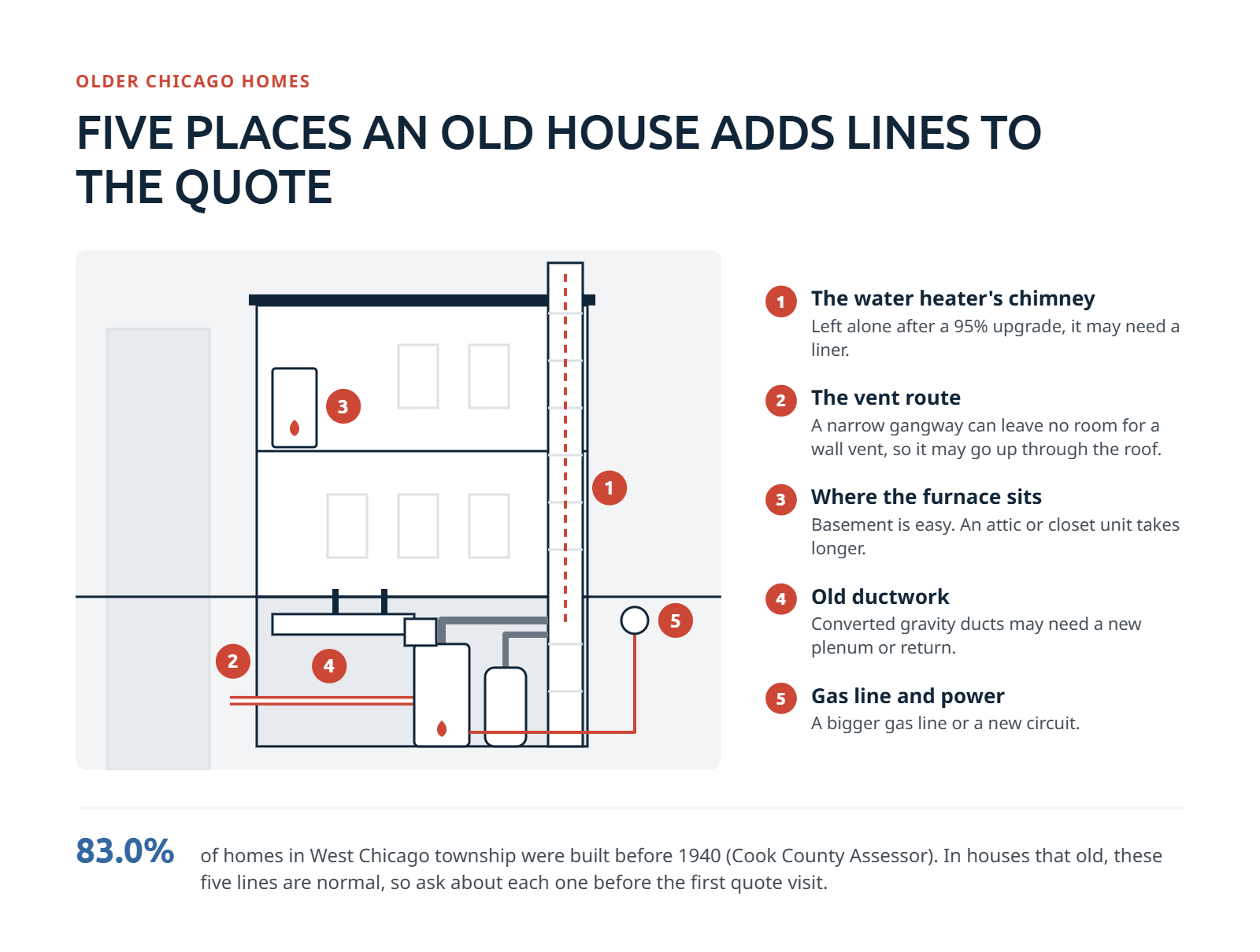
In older Chicago homes, the price moves most with venting, the water heater’s chimney, where the furnace sits, and the ductwork. Cook County Assessor data shows 83.0% of homes in West Chicago township were built before 1940 [4]. In that housing stock, shared chimneys, narrow gangways, attic furnaces, and converted gravity ducts are normal. Each one can add a line to the quote.
The water heater left in the chimney
Many Chicago furnaces share a masonry chimney with a gas water heater. When the furnace moves to 95% and leaves through PVC, the water heater is left alone in a chimney sized for two appliances. That “orphaned” water heater may then need a chimney liner to vent safely.
A liner is chimney work, usually done by a chimney contractor, so expect it as its own line or its own quote. Ask every contractor whether your water heater shares the chimney.
⚠️ Where the new vent can go
A sidewall vent needs clearance from windows, doors, and the property line. On a narrow Chicago lot with a gangway, that space runs out fast. Sometimes the vent has to go up through the roof instead, which costs more.
Ask each contractor to show you where the new vent will leave the house.
Where the furnace sits
A bungalow furnace usually sits in the basement, which is the easy case. A two-flat’s second unit may have its furnace in the attic or a closet. A vintage condo often hides it in a tight utility closet.
⭐ What customers say about awkward installs
“I had a 2-stage furnace and thermostat installed by Eddie and Mike in my condo’s custom utility closet. Installation was challenging and they professionally, patiently, and expertly completed the job.”
– Kathy G., City & Suburban Heating & Cooling Google – Verified Review
“…They seemed unfazed with working with the 120+ year old house whose previous owner did much of his own work.”
– Dora, City & Suburban Heating & Cooling Google – Verified Review
Old ductwork and gas lines
Many pre-war houses still carry large ducts from converted gravity systems, plus a few undersized returns added later. A new furnace may need a new plenum, which is the box that joins the furnace to the ducts, or a new return. A larger or more efficient furnace can also need a bigger gas line or a new electrical circuit. If your ducts leak or are damaged, duct repair is often cheaper done during the install.
✅ Which of these is your house?
Before the first quote visit, check five things:
- Does the water heater share the chimney with the furnace?
- Is there a clear wall for a vent, away from windows and the lot line?
- Is the furnace in the basement, an attic, or a closet?
- Are the ducts original, patched, or recently replaced?
- Is the gas line near the furnace the same size as the one at the meter?
City & Suburban works mostly in Chicago’s pre-war bungalows, two-flats, greystones and gut-rehabbed condos. Those houses have been retrofitted several times, and that history shows up in the quote. I would rather raise the vent route and the chimney question on day one than discover them on install day.
Q6: Should you replace the furnace and AC at the same time?
Replacing the furnace and central AC together usually costs less than two separate jobs, because the coil, line set and labour are shared. Google’s Chicago AI Overview cites about $15,000 for both with major local contractors [10].
When does doing both make sense?
Use a simple rule. Replace both if the AC is near the end of its life. Do the same if it needs a costly repair or will not match the new blower. Otherwise, replace the furnace now and plan the AC.
⚠️ The 2026 refrigerant change
New central ACs now use a newer refrigerant, R-454B, instead of R-410A. The indoor coil sits on top of the furnace and must match the outdoor unit. If you replace only the furnace, ask how the coil will work when the AC is replaced later.
💸 Where the condenser sits changes the price
A condenser in a yard is the simple case. A gangway or a roof adds labour, and some Chicago buildings need a crane to lift a rooftop unit. Ask whether the quote includes that lift.
⭐ What customers say about doing both
“…The pricing was reasonable, so we decided to replace the AC and Furnace at the same time. We are so happy that we chose to do both at once! We were surprised that it was such a quick process to update everything.”
– Janice B., City & Suburban Heating & Cooling Google – Verified Review
“…They replaced my AC and furnace last week and it was just an all around great experience interacting with them.”
– Garrett S., City & Suburban Heating & Cooling Google – Verified Review
City & Suburban installs both furnaces and central air conditioners, so one crew can plan the coil, the line set, and the venting together. When the AC still has years left, I say so and price the furnace on its own.
Q7: What do permits, rebates, tax credits and financing change in 2026?
A furnace replacement is permitted work in the City of Chicago, and each suburb issues its own permit. The federal Energy Efficient Home Improvement Credit (25C) covered property placed in service before December 31, 2025 [2]. A furnace installed in 2026 gets no federal credit. Gas-utility rebates from Peoples Gas, North Shore Gas and Nicor Gas still pay on qualifying 95%+ furnaces [6].
Do you need a permit to replace a furnace in Chicago?
Usually, yes. Chicago treats a furnace replacement as mechanical work that needs a permit and an inspection. The City exempts an in-kind swap (same type, size and shape) in a residential building of up to four stories, and repairs, diagnosis and maintenance do not need one (checked November 2026) [12]. A move from an 80% to a 95% furnace changes the venting, so it is not in-kind. In the suburbs, the village building department issues the permit.
Published permit costs disagree. Four Seasons lists $100 to $300 for permits and inspection [7]. Google’s AI Overviews cite $400 to $1,500, which bundles flue and electrical work [10].
✅ What to ask about the permit
Ask two questions. Is the permit in your price? Will you give me the permit number?
A permit means an inspector checks the gas and venting work. It also protects you when you sell the house or file an insurance claim.
City & Suburban pulls the permit on its furnace installs and schedules the inspection.
Which rebates still apply in 2026?
Chicago homes are served by Peoples Gas. The north suburbs split between North Shore Gas and Nicor Gas, so check your gas bill. Peoples Gas pays $200 on a furnace rated 95% or higher and $225 on one rated 97% or higher, for furnaces installed in 2026, with requests due by December 31, 2026 (checked November 2026) [6]. Nicor Gas pays $150 at 95% AFUE and $225 at 97% AFUE for 2026 installs (checked November 2026) [11].
ComEd’s rebates and the Illinois Home Energy Rebate programs mainly target heat pumps and income-qualified homes. If you are switching fuel, check those too. Our guide to choosing a heat pump instead of a furnace compares what each costs to run in Chicago.
💸 The tax credit is gone
The IRS lists natural gas furnaces as qualifying property only for installs placed in service before December 31, 2025 [2]. Ignore any 2026 quote that subtracts a federal furnace credit. The rebate also arrives after the install, so budget for the full price first.
💰 How can you pay for it?
Most people pay from savings, a home-improvement loan, or the installer’s financing. Compare the total repaid, not the monthly payment. Ask for the rate after any promotional period, the term, and whether you can pay early without a fee.
City & Suburban offers Wells Fargo financing for replacements, subject to credit approval. Check your gas utility’s rebate rules before you sign, so no offset is missed. Our heating services page covers our other heating work.
Q8: How do you tell whether a furnace replacement quote is fair?
A fair furnace quote names the model number, AFUE, BTU, and stages. It says in writing whether the permit, venting, liner, condensate drain, haul-away, and warranties are included. City & Suburban gives free estimates, and its owner does the diagnosis before quoting, so a repair price can sit beside a replacement price. Compare quotes line by line first, and totals last.
How should you line up two or three quotes?
Get two or three written quotes, each with the full model number. Put them side by side against the 15-line checklist from the quote section above. Fill every blank with the contractor’s written answer before you compare totals.
If one quote is far lower, find the missing line before you choose it. Then check the totals against the City’s $6,807 permit median [3] and the published Chicago ranges in the cost section.
⚠️ Red flags on a furnace quote
- No model number, only a brand name
- A size picked without walking through the house
- “No permit needed” for a replacement
- A phone price for an 80% to 95% conversion
- Missing labour or manufacturer warranty lines
- Pressure to sign the same day
⭐ Why a second opinion pays
City & Suburban’s reviews keep returning to one moment: another company quoted a replacement, and a second look found something different.
“When another company purported that I needed to replace my central air conditioning unit, I called Rob from City and Suburban for a second opinion. He quickly diagnosed the problem as a minor leak that could be repaired quickly, and he restored the unit to life at a fraction of the cost that I would have otherwise paid.”
– Mike T., City & Suburban Heating & Cooling Google – Verified Review
“…C&S H&C came and provided a quote on very short notice. Most technically sound solution for our preference and price was competitive vs other quotes.”
– JC, City & Suburban Heating & Cooling Google – Verified Review
“Rob came out to our Rogers Park condo on short notice during a dramatic cold spell and replaced an old furnace. The cost was fair (much lower than other quotes) and the service was very good.”
– Michael N., City & Suburban Heating & Cooling Google – Verified Review
📞 Get a second written quote
If you hold a quote and want it checked, call City & Suburban at (773) 238-3838. You can also use the Schedule Service form on our contact page.
City & Suburban writes every quote on the same 15 lines, so you can hold it against the others. Nobody at City & Suburban is paid more when the answer is replacement.
Q9: Should you repair or replace your furnace, and when?
Replace a furnace when it is near the end of its life and the repair is large. One quick test is the $5,000 rule: multiply the furnace’s age by the repair price, and above $5,000, replacement usually makes more sense. Google’s AI Overview attributes a second test to Chicago contractor Deljo: replace when one repair nears half the price of a new furnace [9] [10]. Plan replacement for spring or early fall.
How do the two rules work?
Take a 20-year-old furnace with a $300 repair: 20 times $300 is $6,000, so the $5,000 rule says replace. Take a 9-year-old furnace with the same repair: $2,700, so repair it. These are rules of thumb, not City & Suburban prices.
The 50% rule needs your replacement quote. If the repair costs half of it or more, a new furnace usually wins.
⚠️ Is it worth replacing a 30-year-old furnace?
Not automatically. If a 30-year-old furnace runs safely and a technician finds nothing wrong, it can keep going. Plan for it, though, so the replacement happens on your schedule instead of in a January breakdown.
City & Suburban attempts repair before it quotes replacement.
⭐ Both outcomes, in customers’ words
“…Rob came by and said the motor was on its last leg – he said we could replace the motor or the whole furnace and gave us pricing for both. We did a bit of online searching and felt the pricing was fair and decided to replace the whole thing.”
– Mardi K., City & Suburban Heating & Cooling Google – Verified Review
“…He explained what he was doing, what he thought about my old furnace, and we agreed to keep fixing it.”
– Heather S., City & Suburban Heating & Cooling Google – Verified Review
“…His thorough and honest assessment saved us at least a couple thousand dollars of trouble shooting with the other companies.”
– Brandon A., City & Suburban Heating & Cooling Google – Verified Review
When is the best time to replace a furnace in Chicago?
Spring and early fall give you time to collect quotes and pick the install date. A furnace that fails in January leaves the least choice. Google’s AI Mode notes that peak-winter emergencies often cost more and miss seasonal promotions [10]. City & Suburban’s own prices and lead times can change by season too.
⏰ Landlords: the heat season is the law
If you own a two-flat or three-flat and supply the heat, the Chicago Heat Ordinance applies from September 15 to June 1. It requires at least 68°F from 8:30 a.m. to 10:30 p.m. and 66°F overnight (checked November 2026) [5]. A furnace near the end of its life is best replaced before September 15.
“…Twice in the past few years, Rob has fixed our aging furnace but this frigid Friday night it kicked the bucket for good. Saturday morning the guys were at our house putting up a new one.”
– Lena H., City & Suburban Heating & Cooling Google – Verified Review
City & Suburban takes emergency heating calls every day until midnight, except Sundays, and comes the same day when the schedule allows. If your furnace is still running, a maintenance plan visit is the cheapest way to learn how much life it has left. For the full lifespan picture, see our guide to how long furnaces last.
Ready for a straight answer on your furnace?
If you are holding a quote, or your furnace is near the end, call me at (773) 238-3838. I will look at the furnace, price the repair beside the replacement, and tell you which one I would choose in your house. You can also book through the Schedule Service form.
About the Author
Robert Koehler is the owner of City & Suburban Heating & Cooling, a family run heating and cooling company in Chicago. His father started the business in 1952, going door to door offering furnace cleaning across the city. Rob runs it today as the second generation.
He still performs service diagnostics himself rather than sending out a salesperson. That is how he ended up with the habit that shows up over and over in the company’s reviews: he repairs systems that other contractors have already quoted for full replacement.
City & Suburban serves Chicago and the near north and northwest suburbs. The company holds a 4.98 average on Google across 204 reviews and 4.9 on Yelp across 251 reviews. It is an American Standard dealer, and its technicians are NATE certified.
You can reach Rob directly at (773) 238-3838.
References
[1] US Department of Energy, Energy Conservation Program: Energy Conservation Standards for Consumer Furnaces, final rule, 88 FR 87502, December 18, 2023. https://www.govinfo.gov/content/pkg/FR-2023-12-18/html/2023-25514.htm
[2] Internal Revenue Service, Energy Efficient Home Improvement Credit, accessed November 12, 2026. https://www.irs.gov/credits-deductions/energy-efficient-home-improvement-credit
[3] City of Chicago Data Portal, Building Permits, single-scope furnace replacement permits, 24 months to August 2026 (81 permits, median declared value $6,807). https://data.cityofchicago.org/Buildings/Building-Permits/ydr8-5enu
[4] Cook County Assessor’s Office, Residential Property Characteristics, West Chicago township, Cook County Open Data. https://datacatalog.cookcountyil.gov/
[5] City of Chicago Department of Buildings, Chicago Heat Ordinance (Municipal Code Section 14X-8-803), accessed November 13, 2026. https://www.chicago.gov/city/en/depts/bldgs/supp_info/chicago-heat-ordinance.html
[6] Peoples Gas and North Shore Gas, Home Energy Rebate Program, residential rebate application. https://www.peoplesgasdelivery.com/resrebateapp
[7] Four Seasons Heating, Air Conditioning, Plumbing & Electric, Average Furnace Replacement Cost in Chicago, January 11, 2026 (data September 2024 to December 2025). https://www.fourseasonsheatingcooling.com/blog/average-furnace-replacement-cost-chicago/
[8] Angi, How Much Does a New Furnace Cost in Chicago, IL?, figures as shown in Google results, November 12, 2026. https://www.angi.com/articles/how-much-does-it-cost-install-new-furnace/il/chicago
[9] Deljo Heating, Cooling & Plumbing, Furnace Installation & Replacement Services in Chicago, IL, accessed November 12, 2026. https://deljoheating.com/heating/furnace-installation/
[10] Google AI Overview and AI Mode answers for “furnace replacement cost”, “how much does a new furnace cost” and “furnace replacement cost chicago”, searched from Chicago through SerpApi, November 12, 2026.
[11] Nicor Gas, Energy Efficiency Rebates for Your Home, 2026 residential rebates, accessed November 13, 2026. https://www.nicorgas.com/ways-to-save/residential-savings/rebates.html
[12] City of Chicago Department of Buildings, What types of work do not require a building permit? Mechanical work, accessed November 13, 2026. https://www.chicago.gov/city/en/sites/guide-to-building-permits/home/help/faq/DOB/bldg-permit-not-required/worktype/mechanical.html
FAQs
A like-for-like furnace swap usually takes less time than a conversion from an 80% to a 95% furnace, because the conversion adds new PVC venting and a condensate drain. At City & Suburban, a like-for-like furnace replacement usually takes one day, and an 80% to 95% conversion takes one to two days.
Three things stretch the day in a Chicago house:
- Access. An attic furnace in a two-flat or a closet furnace in a vintage condo takes longer to remove and set than a basement unit.
- Venting. A new sidewall or roof vent adds work.
- Ductwork. A new plenum or return adds sheet-metal time.
We pull the permit and schedule the inspection, which happen around the install rather than on the day. One of our customers wrote on Google that we "replaced the furnace the day after a reasonable quote was given." That is the pace we aim for when the house and the schedule allow it.
If your furnace has already failed, call us and we will tell you honestly how soon we can restore heat. You can read more about how we plan a heating installation before you book.
A gas furnace should be serviced once a year, ideally before the heating season starts. The filter needs checking more often, usually every one to three months, depending on the filter type and whether you have pets or renovation dust.
A yearly visit does three jobs:
- It catches small faults, such as a dirty flame sensor or a weak igniter, before they stop the furnace on a cold night.
- It keeps the burner and venting working as designed.
- It keeps a new furnace's warranty in good standing, because many manufacturers expect yearly professional maintenance. Check your warranty paperwork.
City & Suburban started in 1952 with furnace cleaning, door to door, and annual service is still the cheapest way we know to stretch a furnace's life. For an older furnace, the yearly visit is also where we tell you honestly how much life it has left, so a replacement never has to be a surprise.
You can book a single heating tune-up, or join a maintenance plan with seasonal check-ups, priority dispatch, and member discounts.
Almost every furnace we replace in Chicago and the north suburbs burns natural gas, and the prices in this guide assume gas. Homes on other fuels have different choices and different costs.
- Electric furnace. Cheaper to buy and simple to install, because there is no venting. It usually costs more to run through a Chicago winter, because electric resistance heat is expensive per unit of heat.
- Oil or propane furnace. Uncommon in our service area. We price these case by case, because fuel storage and venting vary so much.
- Heat pump or hybrid system. If you are changing fuel anyway, a heat pump, or a heat pump paired with a gas furnace for the coldest days, is worth pricing beside a new furnace. ComEd rebates mainly target heat pumps.
City & Suburban installs furnaces, heat pumps, and hybrid systems, so we can price the options side by side for your house rather than pushing one answer. Read how our hybrid heating systems work, or ask us to quote both a furnace and a heat pump on the same visit.
Usually not. Homeowners insurance pays for damage from covered events, such as some fires or floods, named in your policy. A furnace that wears out, cracks with age, or fails from lack of maintenance is normally not covered.
Three things are worth checking:
- Your policy's covered events. If a covered event damaged the furnace, the replacement may be part of the claim.
- An equipment breakdown endorsement. Some policies add this for an extra premium. Read the wording on age and wear.
- A home warranty. These are separate contracts, often with capped payouts and assigned contractors.
If you file a claim, the insurer will want a written diagnosis. City & Suburban's owner does the diagnosis himself, and we write down what failed and why, so you have the record the adjuster asks for. A permit for the replacement also helps, because it shows the new furnace was inspected.
Before any claim, it is worth confirming whether the furnace can simply be repaired. Our guide to Chicago furnace contractors explains what to look for in whoever does that diagnosis.
You can buy a furnace online, and stores list 80% and 95% gas furnaces for roughly $1,190 to $2,565. Finding an installer is the hard part. Many contractors decline customer-supplied equipment, or install it without a labour warranty.
Here is why installers are cautious:
- Sizing. A furnace bought before a load calculation is often the wrong size, and the installer would be fitting a mistake.
- Warranty. Some manufacturers limit or refuse warranty coverage when the furnace was not sold through an authorised dealer.
- Parts and venting. The box rarely includes the venting, condensate, and fittings the house needs, so the savings shrink.
City & Suburban does install a furnace the customer bought. As an American Standard dealer, we can usually show you the installed price beside the online box price, so you can compare the real totals.
If you already own the furnace, contact us with the model number and we will tell you plainly whether it suits your house.