What Size Furnace Do I Need?

What size furnace do I need? In Chicago, it’s the furnace whose output covers your home’s heat loss on a 2°F night, by no more than 40 percent. A room-by-room Manual J load calculation finds that heat loss. A square-foot chart does not.
I’m Rob, and I run City & Suburban Heating & Cooling, the family business my father started in 1952 cleaning furnaces door to door. Say you’re holding two quotes, one for 60,000 BTU and one for 100,000 BTU, and both contractors sounded sure. This guide is for that moment.
Here’s how to read your old furnace, check your house from your gas bill, and judge a quote.
Q1: What size furnace do I need for my Chicago home?
The right furnace is the one whose output is greater than your home’s design heat loss, but no more than 40 percent larger [2]. Manual J, ACCA’s ANSI-recognized load method, finds that heat loss room by room [1]. For Cook County, the design night is 2°F [3]. City & Suburban sizes replacement furnaces this way, and a square-foot chart is only a ballpark.
✅ Four ways furnaces get sized
There are four common ways a furnace size gets picked. Two are weak, and two are good.
| Method | What it uses | Who does it | How good | When it’s fine |
|---|---|---|---|---|
| Square-foot chart (30 to 60 BTU per sq ft) | Floor area and a climate band | Anyone, online | Weak. The range itself spans 2x | A first ballpark only |
| Copy the old furnace | The old data plate | The installer | Weak. Repeats past mistakes | A number to compare against |
| Gas-bill check | Winter therms, degree days, old AFUE | You, with a calculator | Good on a lived-in house | Checking a quote |
| Manual J load calculation | Walls, attic, windows, air leaks, basement, ducts, 2°F design night | The contractor, with software | The standard | Every replacement |
The first two are why quotes disagree. One contractor multiplies square feet by 50. Another reads the old plate and quotes the same size. Neither has measured your house.
⚠️ Why two quotes can be a full size apart
A Chicago house rarely matches the chart. Many of the bungalows and two-flats City & Suburban works in were built before 1940, then got attic insulation and new windows decades later [8]. The chart can’t see any of that.
City & Suburban reads the old furnace’s data plate as evidence, not as the answer. If the old furnace was oversized for 30 years, copying it locks that mistake in for another 20.
⭐ A note on who is writing this
City & Suburban sells and installs furnaces, and it’s my company, so weigh my advice with that stake in mind. The checks below work on any contractor, City & Suburban included.
Second opinions are a big part of what City & Suburban does:
“We had City & Suburban come out for a second opinion on a furnace issue we were having. I’m so glad we did, because we ended up going with them and they were great to work with.”
– Dan H., Google reviewer, September 2025, City & Suburban Heating & Cooling Google – Verified Review
City & Suburban starts every replacement visit by reading the old furnace’s plate and measuring the house, before anyone names a size. When two quotes disagree, the load number settles it.
Q2: How do you find out what size your current furnace is?
Switch the furnace off, remove the upper door, and read the data plate inside. It lists input BTU, output BTU, and a temperature rise range. On most brands, a three-digit group in the model number, such as 060 or 080, is the input in thousands of BTU. Write all three numbers down before anyone quotes you a new size.
✅ Steps, in order
- Turn off power at the service switch next to the furnace. It looks like a light switch.
- Lift off the upper front door. Most pull up and out.
- Find the data plate. It’s usually inside the door or on the cabinet’s side wall.
- Write down the model number, input BTU, output BTU, and the temperature rise range. Temperature rise is how much the furnace warms the air passing through it.
- Take a photo of the plate. Replace the door, then switch the power back on.
You’re done when you have input, output, and the furnace’s age written down. The age is often in the serial number or on the original paperwork.
⚠️ Reading the model number
On many brands, the model number includes a three-digit size code. In a model like “…080…”, 080 usually means 80,000 BTU input. Check it against the input line on the same plate, because brands format model numbers differently.
If you can’t read the plate, ask a City & Suburban technician to read it at your next furnace maintenance visit. It takes a minute, and you’ll have the number before you need it.
⭐ What the old size tells you, and what it doesn’t
The old size tells you what the house has lived with. It does not tell you what the house needs today. Insulation, windows, and a finished basement all change the load.
Q3: What do the BTU numbers on a furnace mean, and how much does a 60,000 BTU furnace heat?
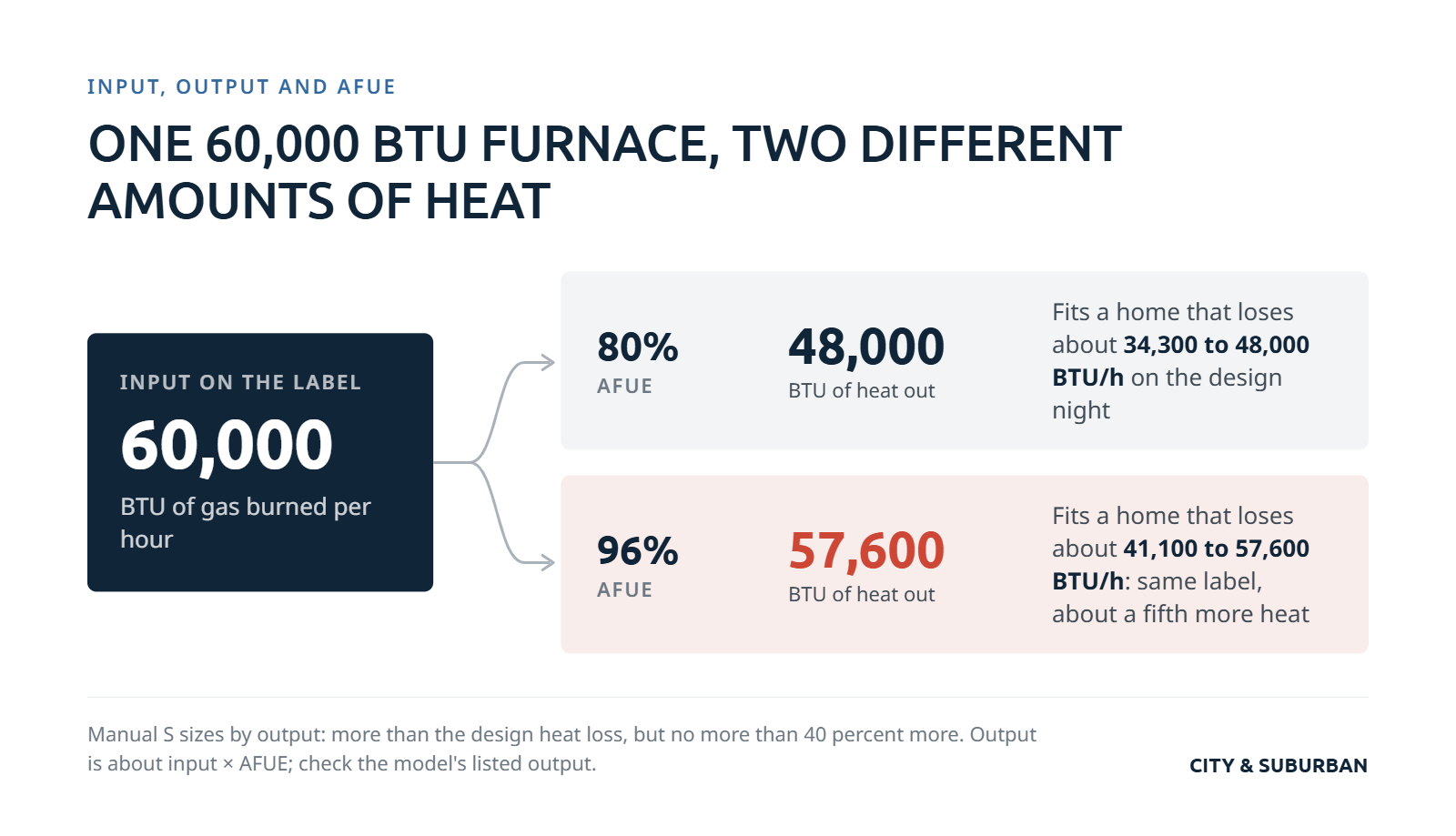
Input is the gas a furnace burns per hour. Output is the heat it delivers to your house. AFUE (annual fuel utilization efficiency) is the share of input that becomes usable heat. A 60,000 BTU input furnace delivers about 48,000 BTU at 80% AFUE, and about 57,600 BTU at 96% AFUE. Manual S says to size by output [2].
✅ Why output is the number that matters
Furnaces are sold by input. Your house only feels output. ACCA’s Manual S puts it plainly: “Always use the output capacity value to size the heating equipment” [2].
That matters when you replace an old 80% furnace with a new high-efficiency one. ENERGY STAR gas furnaces for the northern U.S. are rated 97% AFUE or higher [4]. So “same size as the old one” is already about a fifth more heat.
💰 What each furnace size fits
Output is roughly input times AFUE; use the model’s listed output where you can. Manual S allows output from 100 to 140 percent of the design heat loss [2]. That band gives the last two columns.
| Furnace input | Output at 80% AFUE | Fits a heat loss of | Output at 96% AFUE | Fits a heat loss of |
|---|---|---|---|---|
| 40,000 BTU | 32,000 | about 22,900 to 32,000 BTU/h | 38,400 | about 27,400 to 38,400 BTU/h |
| 60,000 BTU | 48,000 | about 34,300 to 48,000 BTU/h | 57,600 | about 41,100 to 57,600 BTU/h |
| 70,000 BTU | 56,000 | about 40,000 to 56,000 BTU/h | 67,200 | about 48,000 to 67,200 BTU/h |
| 80,000 BTU | 64,000 | about 45,700 to 64,000 BTU/h | 76,800 | about 54,900 to 76,800 BTU/h |
| 100,000 BTU | 80,000 | about 57,100 to 80,000 BTU/h | 96,000 | about 68,600 to 96,000 BTU/h |
| 120,000 BTU | 96,000 | about 68,600 to 96,000 BTU/h | 115,200 | about 82,300 to 115,200 BTU/h |
How much house do 40,000 to 120,000 BTU furnaces heat?
Charts answer in square feet. Carrier’s table puts 50,000 to 60,000 BTU at 1,000 to 2,000 sq ft, and 70,000 to 80,000 BTU at 1,400 to 2,500 sq ft [10]. Google’s AI Overview puts 40,000 to 60,000 BTU at under 1,200 sq ft [13]. Small condos and single units can use furnaces as small as 30,000 BTU.
Those ranges overlap because square feet don’t decide heat loss. The table above answers the better question: what heat loss does each size cover?
⏰ Is 60,000 BTU right for you?
A 60,000 BTU furnace fits a design heat loss of roughly 41,000 to 58,000 BTU per hour at 96% AFUE. At 80% AFUE, the fit is roughly 34,000 to 48,000. It’s too big when your load sits below that range, and too small above it.
City & Suburban writes the new furnace’s output on the quote, next to the old one’s. When a homeowner sees 48,000 becoming 76,800, the “same size” question answers itself.
Q4: How many BTUs per square foot does a Chicago home need?
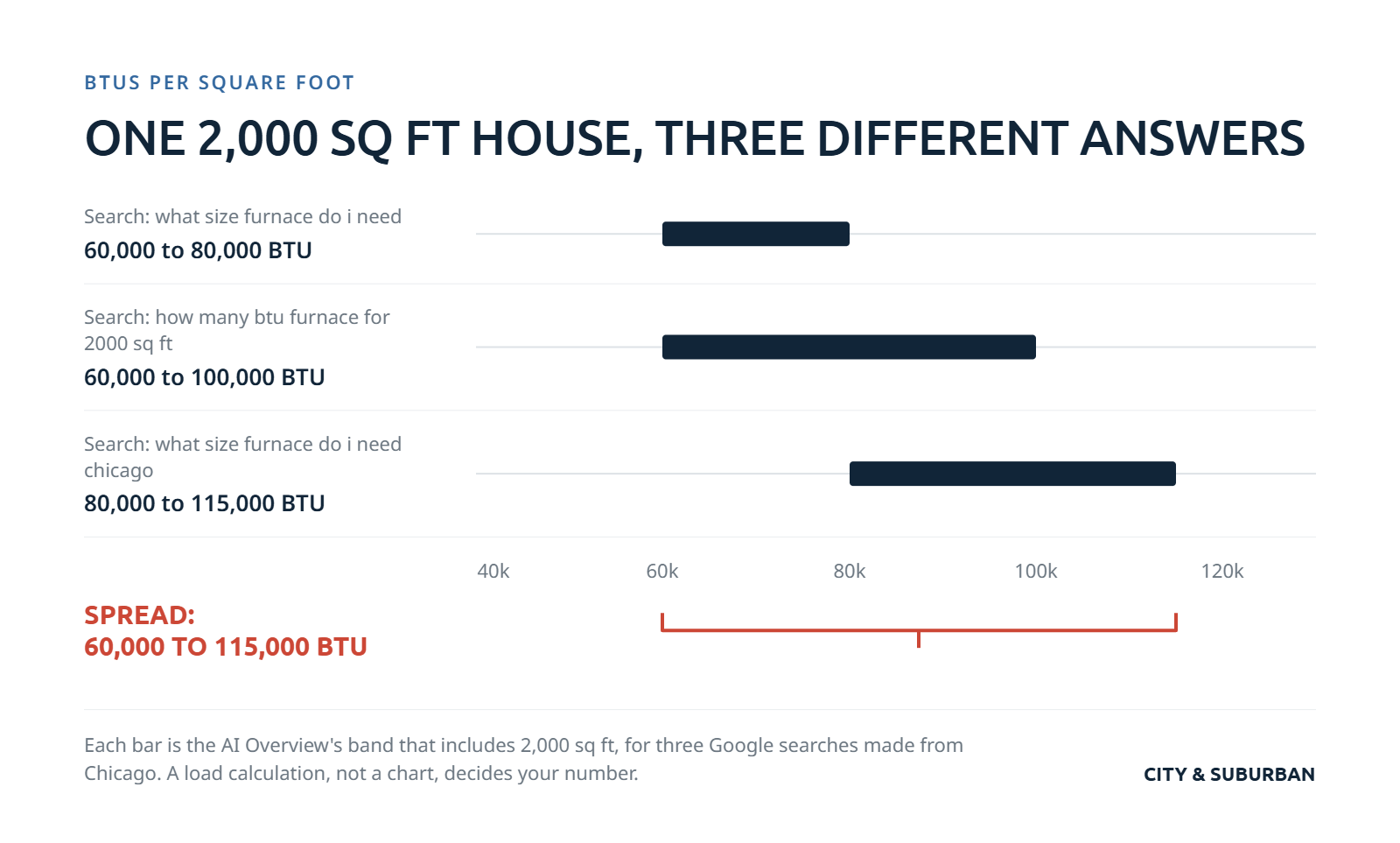
Online charts say 30 to 60 BTU per square foot. For one 2,000 sq ft house, Google’s own answers ranged from 60,000 to 115,000 BTU on the same day in November 2026 [13]. That spread is why the chart is a ballpark. Chicago sits in Climate Zone 5, but your house’s insulation, windows, and basement decide where it lands.
⚠️ The rule comes from marketing pages
The 30 to 60 BTU rule appears on Bryant’s guide, Universal HVAC Group’s calculator, and Google’s AI Overview [12][14][13]. City & Suburban could not trace it to a primary dataset. It traces to contractor and manufacturer marketing pages, so treat it that way.
Even the sources that print it hedge it. Carrier labels its own ranges “general reference ranges, not equipment-sizing recommendations” [10].
What do the charts say for 1,000 to 3,000 square feet?
| Home size | What Google’s AI Overview said (Nov 2026) | Check this before you believe it |
|---|---|---|
| Under 1,200 sq ft | 40,000 to 60,000 BTU | Is it a condo or unit with neighbors on two sides? |
| 1,200 to 1,500 sq ft | about 40,000 to 50,000 BTU | Has the attic been insulated? |
| 1,600 to 2,000 sq ft | 60,000 to 80,000 BTU | Are the windows original single-pane? |
| 2,000 sq ft | 60,000 to 100,000 BTU | Is the basement finished and heated? |
| 2,000 to 3,000 sq ft | 80,000 to 115,000 BTU | Vaulted ceilings, or a top-floor unit? |
| 3,000+ sq ft | 90,000 to 125,000+ BTU | One furnace, or two systems by floor? |
⭐ Why old Chicago houses break the chart
Google’s AI Mode says older Chicago bungalows and greystones need “closer to 50 to 60 BTUs per sq ft” [13]. That treats every old house as untouched. Most aren’t.
In the Cook County Assessor’s data, 83.0% of West Chicago township properties were built before 1940 [8]. Many have since had attics blown in, windows replaced, and walls opened during rehabs. Those changes cut heat loss, sometimes by a lot.
City & Suburban compares the chart number with a real load before quoting. If the chart and the load calculation agree, fine. If they don’t, the load calculation wins.
Q5: What happens if a furnace is oversized or undersized?
An oversized furnace heats in short bursts and shuts off, which leaves far rooms cool, blasts air through the registers, and wears parts faster. An undersized furnace runs nonstop on the coldest nights and still falls behind the thermostat. City & Suburban checks the filter, flame sensor, and thermostat first, because short cycling is often a dirty part, not the size.
⚠️ Signs your furnace is too big
These show up in roughly this order:
- Short cycles. The burners run only a few minutes, shut off, then start again soon after.
- Uneven rooms. The room near the furnace overheats while the back bedroom stays cool.
- Loud air. Registers whoosh at the start of every cycle.
- High-limit trips. The furnace shuts itself off because the air inside got too hot.
❌ Rule out the look-alikes first
Short cycling has cheaper causes than size. A clogged filter, a dirty flame sensor, or a thermostat on a warm wall can all cut cycles short. A misplaced or failing thermostat is a common one; City & Suburban’s thermostat repair guide covers it.
One homeowner found exactly this:
“Recently bought a new home and the furnace had been short cycling. Their sticker was on the furnace so I called them to come out and take a look. Turns out parts needed cleaning that stopped the short cycling issue. Furnace is nearing its useful life but not yet! Thanks Rob!”
– Jessica F., Google reviewer, November 2025, City & Suburban Heating & Cooling Google – Verified Review
If a new filter and a cleaned sensor don’t fix it, City & Suburban will check whether the size is the cause. Book that as a furnace repair visit, not a replacement quote.
⏰ Signs your furnace is too small
An undersized furnace runs without stopping on the coldest nights and still can’t hold the thermostat setting. Judge it against the setting, not against how cozy the house feels.
For Chicago landlords, this matters more. The Chicago Heat Ordinance requires at least 68°F from 8:30 a.m. to 10:30 p.m. and 66°F overnight, from September 15 to June 1, where the landlord supplies heat [6].
Is it better to undersize or oversize a furnace?
Neither. The target is output between 100 and 140 percent of your design heat loss [2]. Trane’s guide sets a similar heating cap at “40% of the BTUs” [11].
In Chicago, a small miss on the big side is the safer one. A large miss on the big side brings every symptom above.
Does a two-stage or modulating furnace make sizing less risky?
Partly. A two-stage or modulating furnace runs at a lower setting most of the winter, so a little extra size costs less comfort. It still has to be sized from the load.
If your load sits between two sizes, a two-stage furnace in the bigger size is the usual fix. It is not a reason to skip the load calculation.
“I had a 2-stage furnace and thermostat installed by Eddie and Mike in my condo’s custom utility closet. Installation was challenging and they professionally, patiently, and expertly completed the job.”
– Kathy G., Google reviewer, September 2025, City & Suburban Heating & Cooling Google – Verified Review
City & Suburban rarely tells a homeowner to replace a healthy furnace just because it’s oversized. Note the oversize, then size down when replacement is due. Heather S. described the usual outcome:
“…He explained what he was doing, what he thought about my old furnace, and we agreed to keep fixing it…”
– Heather S., Google reviewer, December 2025, City & Suburban Heating & Cooling Google – Verified Review
Q6: What is a Manual J calculation, and what does it measure in a Chicago home?
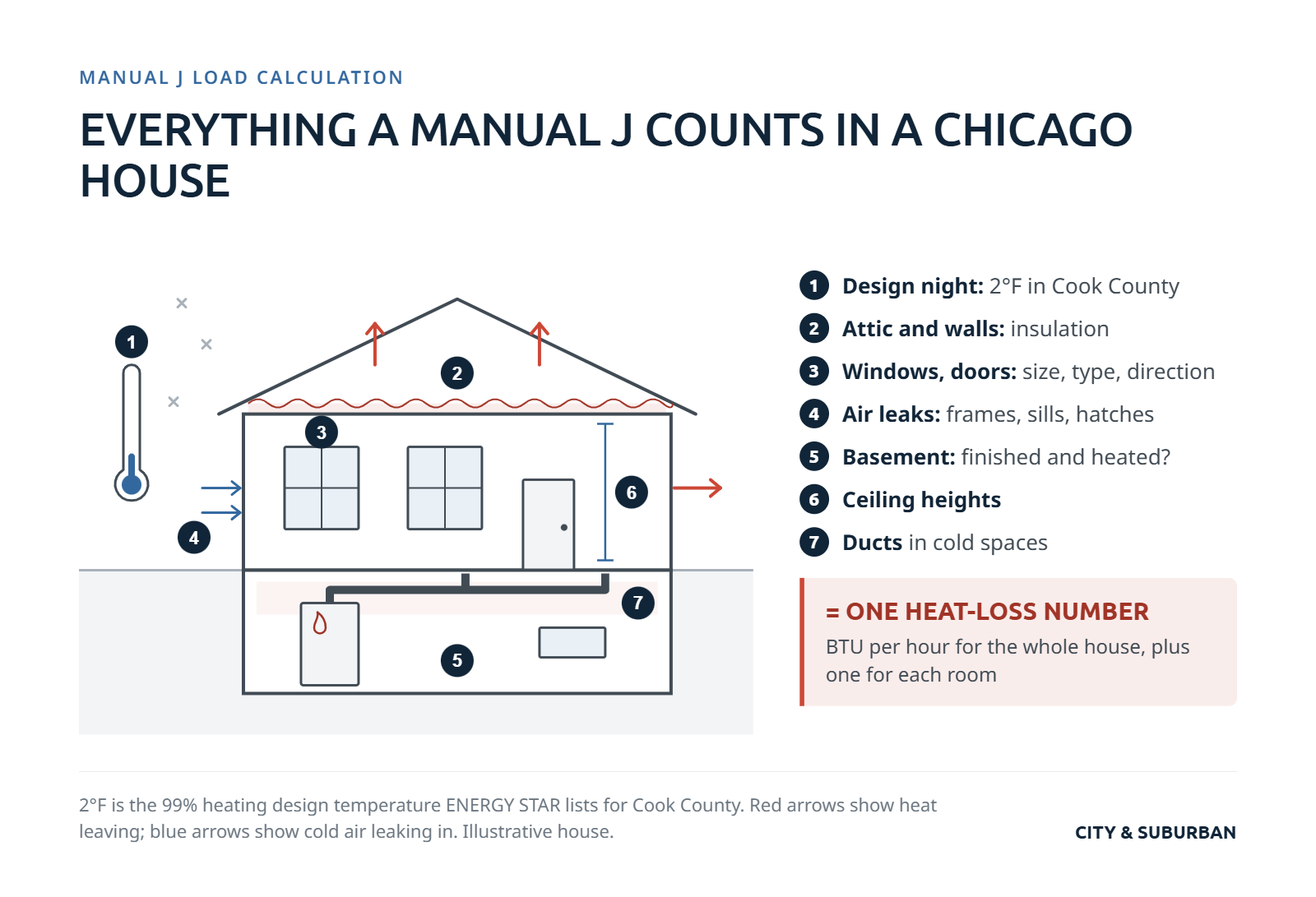
A Manual J calculation is ACCA’s method for working out how much heat each room loses on the coldest normal winter night. ACCA calls it “the national ANSI-recognized standard for producing HVAC equipment sizing loads” [1]. For Cook County, that night is 2°F [3]. City & Suburban uses Manual J to size replacement furnaces, then picks the furnace from the result.
✅ What goes into it
A Manual J counts every way your house loses heat:
- Design temperature. ENERGY STAR lists 2°F as Cook County’s 99% heating design temperature, from Manual J’s Chicago data [3]. That is a cold normal night, not the record low.
- Walls and attic. How much insulation is in each, and what kind.
- Windows and doors. Count, size, type, and which way they face.
- Air leakage. How much cold air sneaks in around old frames, sill plates, and attic hatches.
- Basement. Its walls and floor, and whether it’s finished and heated.
- Ceiling heights. Ten-foot greystone ceilings hold more air than eight-foot ones.
- Ducts. Whether they run through a cold attic or crawlspace.
⭐ What the report looks like
A real Manual J gives you two things. One is a whole-house heat loss in BTU per hour. The other is a number for each room, which also guides duct and register sizing.
ACCA says a Manual J load calculation “is required by national building codes and most state and local jurisdictions” [1]. So asking for the report is asking for normal paperwork, not a favour.
✅ Manual S and Manual D, in one line each
- Manual S picks the furnace from that number: output above the load, but no more than 40 percent above it [2].
- Manual D checks that the ducts can carry the air the new furnace moves.
You’re done when you hold a report with a whole-house heat loss, not just a model number.
City & Suburban measures the attic, basement, windows, and ducts on the replacement visit, then runs the load before naming a size.
Q7: How can you check your furnace size from your gas bill?
Your winter gas use shows how much heat your house actually lost. Take a cold month’s heating therms, divide by that month’s heating degree days, and scale the result to Chicago’s 2°F design night. Compare the answer with your furnace’s output. If the output is well over 140 percent of it, the furnace is probably oversized.
✅ The steps
- Find a cold-month bill. Peoples Gas in the city, Nicor in most suburbs. Note the therms and the billing dates.
- Find a summer bill. Its therms are your water heater and stove. Subtract them from the winter therms.
- Look up heating degree days for those dates. Heating degree days measure how cold it was against a 65°F base. Some gas utilities print them on the bill, and the National Weather Service publishes them [5].
- Work out heat loss per degree. Heating therms × 100,000 × your old furnace’s AFUE, divided by (degree days × 24).
- Scale to the design night. Multiply by 63, the gap between 65°F and Cook County’s 2°F design temperature [3].
💰 A worked example (example numbers, not a real house)
Say January used 180 heating therms over 1,200 degree days, with an 80% AFUE furnace:
- 180 × 100,000 × 0.80 = 14,400,000 BTU of heat delivered.
- 1,200 × 24 = 28,800 degree-hours.
- 14,400,000 ÷ 28,800 = 500 BTU per hour, per degree.
- 500 × 63 = 31,500 BTU per hour design heat loss.
That house’s 60,000 BTU, 80% furnace delivers 48,000 BTU. That’s about 152 percent of the load, above the 140 percent ceiling [2]. A 40,000 BTU, 96% furnace (38,400 output) would land at about 122 percent.
How furnace size sets run time as it gets colder
Mild day. At 45°F this example house loses about 10,000 BTU an hour through its roof, walls and windows. The right-size furnace puts out 38,400, so it covers that by running about a quarter of each hour. Turn on "Oversized furnace" to compare.The oversized furnace puts out 64,000, so it covers that in three short bursts, about 10 minutes in all.
Cold day. At 25°F the gap to indoors has doubled, and so has the heat loss: 20,000 BTU an hour. The furnace's output doesn't change, so its run time doubles instead, to about half of each hour.The oversized furnace still covers it in five short bursts, about 19 minutes in all.
Design night. Manual J sizes for Cook County's 2°F design night, when this house loses 31,500 BTU an hour. The 40,000 BTU, 96% furnace (38,400 output) is about 122 percent of that, under the 140 percent cap, so it runs almost continuously.The 80,000 BTU, 80% furnace (64,000 output) is about twice the load, far past the 140 percent cap, so even tonight it runs in short bursts.
Run-time check. A smart thermostat's run-time report for a day near 2°F shows this: a furnace inside the 100 to 140 percent band runs roughly 70 to 100 percent of each hour. This one runs about 82 percent, so its size fits the house.This one runs under half of each hour, so it's about twice the size the house needs. Short bursts like these leave far rooms cool, blast air through the registers and wear parts faster.
The house is the article's gas-bill example (example numbers, not a real house): it loses 500 BTU an hour per degree below 65°F, so 31,500 BTU/h on the 2°F design night. The 45°F and 25°F days and the on/off patterns are examples. Outputs are input × AFUE, from the sizing table.
⏰ The second check, with no math
Open your smart thermostat’s run-time report for a day near 2°F. A furnace sized inside the 100 to 140 percent band should run roughly 70 to 100 percent of each hour. If yours ran less than half of each hour, it’s about twice the size your house needs.
⚠️ What this check can’t do
It works for a house you’ve lived in through a winter. It’s no use for a house you’re buying, a new addition, or a house you’re about to insulate. The same heat-loss number also sizes a heat pump or a hybrid heating system.
If you’re also weighing a heat pump, our heat pump vs furnace guide compares the two for Chicago homes.
If your gas-bill number and a contractor’s quote are more than one furnace size apart, ask the contractor to walk you through their inputs. City & Suburban will check your numbers against a load calculation on the replacement visit. Call (773) 238-3838, or use the Schedule Service form.
Q8: What size furnace does a Chicago bungalow or two-flat need?
It depends on what has been done to the house since it was built. The year a house was built tells you less than its attic, windows, and basement do today.
⭐ Older brick homes
Old Chicago homes bring surprises a chart can’t predict. Dora described one:
“…He also gave me an estimate for the basement furnace, which I knew needed replacing… Mike and Eddie showed up to remove the old furnace and install the new. They seemed unfazed with working with the 120+ year old house whose previous owner did much of his own work…”
– Dora, Google reviewer, September 2025, City & Suburban Heating & Cooling Google – Verified Review
⭐ Condos
Michael N. had an old furnace replaced in his condo:
“Rob came out to our Rogers Park condo on short notice during a dramatic cold spell and replaced an old furnace. The cost was fair (much lower than other quotes) and the service was very good…”
– Michael N., Google reviewer, December 2025, City & Suburban Heating & Cooling Google – Verified Review
City & Suburban works across the North Side, including Rogers Park.
✅ Two-flats: one furnace per unit
Most Chicago two-flats have one furnace per unit, each sized for its own floor. The top floor loses heat through the roof. The garden unit loses it through basement walls. They rarely need the same size.
City & Suburban sizes each unit’s furnace from that unit’s own load, not from the other unit’s plate.
Our guide to furnace replacement cost in Chicago shows what changes the price.
Q9: Do your ductwork and air conditioner limit what size furnace you can install?
Yes. Your ducts have to carry the furnace’s heat without overheating it, and the furnace’s blower has to move enough air for your air conditioner. In older Chicago homes with small ducts, those two limits can rule out a bigger furnace even when a chart calls for one. City & Suburban checks both before it settles on a size.
⚠️ The temperature-rise check
Every furnace’s data plate lists a temperature rise range. That’s how much the furnace may warm the air passing through it. Manual S ties heating airflow to that requirement [2].
A furnace too big for its ducts pushes the rise above the plate’s range. It then trips its high-limit switch and shuts down. That looks like short cycling, but the cause is the ducts, not the burner.
✅ Matching the air conditioner
In a house with central air, the furnace’s blower also moves the cooled air. So the furnace is often chosen for its blower size, to match the AC’s tonnage, as much as for its heat.
When both units are near the end of their lives, replacing them together lets them be matched properly. City & Suburban’s guide to sizing an air conditioner for a Chicago home covers the cooling side.
“…The pricing was reasonable, so we decided to replace the AC and Furnace at the same time. We are so happy that we chose to do both at once!…”
– Janice B., Google reviewer, August 2026, City & Suburban Heating & Cooling Google – Verified Review
⭐ What to ask
Ask the contractor: “Did you check my duct sizes and static pressure?” Static pressure is how hard the blower has to push against the ducts. You’re done when the quote names both the heat output and the airflow.
City & Suburban checks duct size and static pressure on every replacement visit. Where the ducts are the limit, we quote duct repair or a matched air conditioning installation alongside the furnace, never a bigger furnace on the same small ducts.
Q10: What should a contractor do to size your new furnace?
A contractor should measure your house, run a room-by-room Manual J load calculation, show you the number, and compare it with the new furnace’s output. A quote that only says “same size as before” or “about 50 BTU a square foot” hasn’t been sized.
✅ Five questions to ask before you accept a quote
- What heat loss did you calculate for my house?
- Can I see the load report?
- What output does the new furnace have, and how does it compare with the heat loss?
- Did you check the ducts and the air conditioner match?
- Is the permit included?
❌ Red flags
- Nobody went into the attic or the basement.
- The size was quoted over the phone.
- The contractor recommends a bigger furnace “to be safe”.
- The quote lists only a model number, with no output.
💸 What the permit records show
Furnace replacements in Chicago need a City of Chicago permit, and the suburbs have their own. City of Chicago permit records list 81 single-scope furnace replacement permits in the 24 months to August 2026. Their median reported value is $6,807 [7]. That’s reported construction value for the whole project, not a quote.
The City’s Express Permit application for replacing heating equipment asks for a photo of the existing equipment and an energy efficiency compliance form. It asks for an HVAC load calculation only when a new heat pump or air conditioner is added, not for a replacement (checked November 2026) [15]. So the permit paperwork won’t show whether your new furnace was sized from a load calculation. Ask the contractor for the report.
⭐ Why the incentive matters
At large multi-trade companies, the person quoting is often a commission-paid comfort advisor. A bigger, pricier furnace pays that person more. That isn’t dishonest, but it’s the direction the incentive points.
Homeowners notice when nobody pushes. Nick U. wrote:
“…Rob (the owner) didn’t hard sell us on the latest and greatest generation of HVAC systems with added bells and whistles. He laid out the few options best suited to our condo’s layout…”
– Nick U., Google reviewer, September 2025, City & Suburban Heating & Cooling Google – Verified Review
“…No Pressure: We even asked if we should replace the furnace and upgrade to a two-stage AC, and he gave us honest advice instead of pushing a massive, expensive project…”
– Nisha J., Google reviewer, June 2026, City & Suburban Heating & Cooling Google – Verified Review
City & Suburban is owner-run. I do the diagnosis myself, and nobody here earns more for a bigger furnace. City & Suburban handles the Chicago permit and inspection on replacements, and the furnace installation page explains the process. For more on choosing a company, see our furnace service guide.
⏰ Get your house sized
If you have a quote and want a second look at the size, call City & Suburban at (773) 238-3838. You can also use the Schedule Service form. Estimates are free. If your old furnace is healthy, I’ll tell you that too.
About the Author
Robert Koehler is the owner of City & Suburban Heating & Cooling, a family run heating and cooling company in Chicago. His father started the business in 1952, going door to door offering furnace cleaning across the city. Rob runs it today as the second generation.
He still performs service diagnostics himself rather than sending out a salesperson. That is how he ended up with the habit that shows up over and over in the company’s reviews: he repairs systems that other contractors have already quoted for full replacement.
City & Suburban serves Chicago and the near north and northwest suburbs. The company holds a 4.98 average on Google across 204 reviews and 4.9 on Yelp across 251 reviews. It is an American Standard dealer, and its technicians are NATE certified. Read more about City & Suburban.
You can reach Rob directly at (773) 238-3838.
References
- ACCA, “Manual J: Residential Load Calculation” (ANSI/ACCA 2 Manual J, 8th Edition), accessed 12 Nov 2026. https://www.acca.org/standards/technical-manuals/manual-j
- ACCA, “Understanding and Using the HVAC Design Review Form” (quotes Manual S §2-2, §2-3 and the Manual S sizing table, 2009 IRC M1401.3), accessed 12 Nov 2026. https://www.hvacrschool.com/wp-content/uploads/2019/06/HVAC-Design-Review-Form-Instructions-4-10.pdf
- US EPA / ENERGY STAR, “Design Temperature Limit Reference Guide (2015 Edition)”, Cook County, Illinois, accessed 12 Nov 2026. https://www.energystar.gov/sites/default/files/asset/document/Design%20Temperature%20Limit%20Reference%20Guide%20%282015%20Ed%29%20-%20ENERGY%20STAR%20Certified%20Homes_Rev10.pdf
- ENERGY STAR, “Furnaces Key Product Criteria”, accessed 12 Nov 2026. https://www.energystar.gov/products/heating_cooling/furnaces/key_product_criteria
- US Energy Information Administration, “Degree-days”, accessed 12 Nov 2026. https://www.eia.gov/energyexplained/units-and-calculators/degree-days.php
- City of Chicago, Heat Ordinance, Chicago Municipal Code 13-196-410. https://www.chicago.gov/city/en/depts/bldgs/supp_info/heat-ordinance.html
- City of Chicago, Building Permits dataset, 24 months to August 2026, 81 single-scope furnace replacement permits. https://data.cityofchicago.org/Buildings/Building-Permits/ydr8-5enu
- Cook County Assessor, Residential Property Characteristics, West Chicago township. https://datacatalog.cookcountyil.gov/
- City & Suburban Heating & Cooling, Google Business Profile reviews, September 2025 to August 2026 (linked inline).
- Carrier, “Calculating Furnace Size”, accessed 12 Nov 2026. https://www.carrier.com/us/en/residential/hvac-resources/furnaces/calculating-furnace-size/
- Trane, “What Size HVAC Unit Do I Need?”, accessed 12 Nov 2026. https://www.trane.com/residential/en/resources/blog/size-hvac-unit-need/
- Bryant, “What Size Furnace Do I Need? BTU Sizing Guide”, accessed 10 Nov 2026. https://www.bryant.com/en/us/products/gas-furnaces/what-size-furnace-do-i-need/
- Google AI Overview and AI Mode answers for “what size furnace do i need”, “how many btu furnace for 2000 sq ft” and “what size furnace do i need chicago”, searched from Chicago via SerpApi, 12 Nov 2026.
- Universal HVAC Group, “Furnace Size Calculator”, accessed 12 Nov 2026. https://universalhvacgroup.com/furnace-size-calculator/
- City of Chicago Department of Buildings, “Express Permit Program: Mechanical (HVAC) Work” (eligibility and required documents), accessed 13 Nov 2026. https://www.chicago.gov/city/en/sites/guide-to-building-permits/home/instructions/EPP/MECH.html
FAQs
Yes. A heated, finished basement adds to your home's heat loss, and a proper load calculation counts it separately from the floors above.
A Manual J looks at the basement's walls, its floor, any windows, and how much of the wall sits above ground. In many Chicago bungalows and two-flats, the basement was unheated storage for decades, then became a family room or a garden unit. That change can add real load the old furnace was never sized for.
- If the basement is finished but has no supply registers, it may be borrowing heat from the floor above.
- If it has registers but stays cold, the problem may be duct layout, not furnace size.
- If it's a separate unit, it usually needs its own heat source or its own zone.
City & Suburban measures the basement as part of the load calculation on a replacement visit, so the new furnace is sized for the house as you use it today, not as it was built. We also check whether the existing ducts can actually reach the basement before suggesting a bigger furnace. You can read how that visit works on our furnace installation page.
Not because of size alone. Google's AI Overview mentions "dual furnaces" for larger homes, but one furnace can usually make enough heat for 3,000 square feet. The reason homes get two systems is usually air, not heat.
Here's what actually drives the choice:
- Long duct runs. If the far rooms are a long way from the furnace, one blower may not move air evenly to every floor.
- Floors that behave differently. A top floor under the roof and a basement level lose heat at different rates and want different settings.
- Comfort control. Two systems, or one system with zoning, let each floor run on its own thermostat.
A load calculation gives the room-by-room numbers that show whether one furnace with good ducts and zoning will do, or whether two systems make more sense. City & Suburban looks at the duct layout as well as the heat loss before recommending either. When ducts are the limit, duct repair or zoning is often cheaper than a second furnace. We'll show you both options.
Often, yes. Insulation, air sealing, and better windows all cut your home's heat loss, so a new load calculation may land a size or two below the furnace you have now.
This comes up constantly in older Chicago homes. A bungalow that got blown-in attic insulation and replacement windows loses far less heat than it did when the original furnace went in. If the replacement simply copies the old size, the new furnace starts life oversized.
- Do the insulation and window work first, if it's planned. Size the furnace after.
- Ask the contractor to enter the upgrades in the load calculation, not the house's original condition.
- Expect the new furnace's output to land between 100 and 140 percent of the new heat loss.
A smaller furnace that fits the house runs longer, steadier cycles, which usually means more even rooms and less wear. City & Suburban sizes replacements from the house as it stands today, upgrades included. If you're planning upgrades and a furnace in the same year, tell us the order and we'll time the load calculation to match.
Size affects price less than most people expect. For a 2,000 square foot home, the cost depends more on efficiency, venting, ductwork, and permits than on whether the furnace is 60,000 or 80,000 BTU.
City of Chicago permit records give one public reference point. Over the 24 months to August 2026, 81 single-scope furnace replacement permits had a median reported value of $6,807. That's reported construction value for the whole project, not a quote, and it varies with the job.
- Efficiency. A 96% or higher AFUE furnace usually costs more than an 80% unit, and it needs different venting.
- Venting. Moving from a chimney to a sidewall vent adds work in many older homes.
- Ductwork. Undersized ducts may need changes before any furnace runs well.
City & Suburban gives free estimates on replacements. Financing through Wells Fargo is available for replacements. Start with our furnace installation page or call (773) 238-3838.
Only if a new load calculation says so. An addition adds heat loss, but your current furnace may already have room to cover it, especially if it was oversized to begin with.
Here's how City & Suburban approaches it:
- Run the load for the whole house, addition included. Compare it with your current furnace's output. If the output still sits within 100 to 140 percent of the new load, the furnace can stay.
- Check whether the ducts can reach. Extending ducts into an addition is often the harder part. A furnace with enough heat can't help a room the air never gets to.
- Consider separate heat. For a sunroom, a finished attic, or a room far from the furnace, a ductless mini-split can be simpler than a bigger furnace.
City & Suburban runs that comparison before suggesting any change, because replacing a healthy furnace just to cover one new room is rarely the right answer. If separate heat makes more sense, our ductless HVAC service page explains how mini-splits work in additions with no duct path.