Furnace Repair Cost in Chicago: What Each Repair Really Costs

Furnace repair cost in Chicago comes down to one question: which part failed. Most repairs are a single part, and national published ranges run from about $80 for a flame sensor to $3,000 for a heat exchanger [1]. Below: what each repair costs, why the price moves, and when I’d tell you not to pay for it.
Picture a January night in a Chicago two-flat. The furnace has stopped, the basement is cold, and the first company out has left a quote for a whole new system on your phone. Before you sign, you want to know one thing: is that number fair? This page answers it, part by part.
Q1: How much does furnace repair cost in Chicago?
Most furnace repairs replace one failed part, so the part sets the price. American Standard’s national ranges run from $80 to $240 for a flame sensor to $1,000 to $3,000 for a heat exchanger [1]. Motors sit in between, with an inducer motor at $400 to $1,100. The table below lists the common Chicago repairs by symptom, with the national range for each, so you can find your symptom and read across.
💰 The price table, symptom first
Start with what you see or hear, then read across. A technician still confirms the part with a test, but this puts you within range first.
| Repair | What you notice | National range [1][2] |
|---|---|---|
| Flame sensor (clean or replace) | Burners light, then shut off after a few seconds | $80 to $240 |
| Igniter | No glow, no flame, furnace locks out | $100 to $250 |
| Pressure switch | Inducer runs, burners never light | $150 to $350 |
| Limit switch | Furnace shuts off and restarts on its own | $100 to $375 |
| Condensate pump | Water by the furnace, shuts down in hard cold | $250 to $440 |
| Inducer motor | Whine, rattle or hum at start-up | $400 to $1,100 |
| Blower motor (single-speed) | No air from vents, burning smell | $450 to $900 |
| Control board | No response, wrong blink code | $300 to $650 |
| Gas valve | Igniter glows, no gas, no flame | $200 to $800 |
| Heat exchanger | Found on inspection, flame disturbed by blower | $1,000 to $3,000 |
⚠️ Why national ranges can mislead you
National ranges are averages from many markets. American Standard’s table was compiled “with the help of Forbes,” not from a single company’s invoices [1]. Chicago prices move with cold snaps, basement access and part waits, which Q7 covers.
⭐ What a typical call looks like
Most furnace repairs come down to one part, not a list. A customer described a typical visit plainly:
“Rob, the service tech, showed up on time to help me out. He told me he had to change out one part to get it up and running again, which he did in a very timely manner. And, without breaking the bank.”
– Doug S., City & Suburban Heating & Cooling Google – Verified Review
City & Suburban’s read is that the honest price of a furnace repair is the part plus the time it takes to reach it. Everything else on a quote should be explainable in one sentence.
City & Suburban discloses its service call fee up front and credits it toward the repair. Rob, the owner, performs the diagnosis on service calls himself. So each row starts with a symptom and ends with a tested part, not a guess.
Q2: What does a furnace service call cost before any repair?
A furnace service call pays for the trip and the diagnosis. Nationally it runs about $50 to $200, with labour at $75 to $150 an hour and after-hours rates as much as double or triple [1]. City & Suburban’s service call fee is $89, credited toward the repair, plus $75 after hours. It takes calls every day until midnight except Sundays.
⏰ What the fee actually buys
The fee covers the visit and the readings that find the failed part. A good diagnosis is worth paying for, because it stops you buying the wrong part. At City & Suburban, the $89 fee is credited toward the repair.
Ask two things on the phone: is the fee credited to the repair, and does the rate change in the evening or on Saturday?
✅ Six checks before you pay anyone
Some no-heat calls are fixed by the homeowner in five minutes. Check these first, or use our full checklist for when a furnace won’t turn on:
- Thermostat set to heat, and set above room temperature.
- Furnace power switch on (it looks like a light switch near the unit).
- Breaker not tripped.
- Filter not clogged.
- Front panel seated, since a loose panel stops the furnace.
- Gas valve handle in line with the pipe.
If you smell gas, leave the house first. Then call Peoples Gas (Chicago) or Nicor Gas (suburbs) from outside, before any contractor.
💸 When an evening call is worth it
Chicago landlords carry a legal duty. From September 15 to June 1, rental units must be kept at 68°F from 8:30 a.m. to 10:30 p.m., and 66°F overnight [4]. The rule is the Chicago Heat Ordinance, Section 14X-8-803 of the Municipal Code, and the Department of Buildings enforces it. Where each unit has its own furnace, the landlord must keep it in good working order (checked November 2026) [8]. For a two-flat owner with a tenant, an evening call is a compliance cost, not a luxury.
For an owner-occupied house that will stay safe overnight, booking the morning usually saves money. The hours matter too, as one customer found:
“I called on a Sunday night because my furnace wasn’t working. The repair person was here first thing on Monday morning.”
– Russell K., City & Suburban Heating & Cooling Google – Verified Review
“Our HVAC technician responded to my text at 10:00 PM the night before the coldest day of the year … he restored heat quickly so our tenant could remain safe and comfortable in freezing temperatures.”
– Lone W., City & Suburban Heating & Cooling Google – Verified Review
City & Suburban’s intake takes the fault description before anyone is sent, so the van can arrive with the likely part. Tell Carissa, or Rob or Eddie after hours, exactly what the furnace is doing. That one call can save a second visit.
Q3: What do igniters, flame sensors and other small furnace repairs cost?
Small furnace repairs usually cost a few hundred dollars each. American Standard’s national ranges put an igniter at $100 to $250 and a flame sensor at $80 to $240 [1]. Pressure switches, limit switches and transformers run $100 to $375. A condensate pump runs $250 to $440, and a thermostat $100 to $600 [1].
✅ Match the symptom to the start-up step
A gas furnace starts in the same order every time. The thermostat calls for heat, the inducer motor starts, and the pressure switch proves the vent is clear. Then the igniter glows, the gas valve opens, the flame sensor proves the flame, and the blower sends heat through the house.
Whatever step it stops at points to the likely part. No glow points to the igniter. A flame that lights and drops out after a few seconds points to the flame sensor. An inducer that runs with no ignition points to the pressure switch.
Which part failed? Follow the furnace's start-up order
Control board. The board is the furnace's brain: it takes the thermostat's call and switches each part on in turn. When something fails, it flashes a blink code that points to a fault, not always to the board itself. A board runs about $300 to $650 nationally, so ask what was tested to rule out cheaper parts.
Inducer and pressure switch. Before any gas flows, the inducer motor pulls exhaust out through the flue, and the pressure switch proves the vent is clear. A whine, rattle or hum at start-up points to the inducer, about $400 to $1,100 nationally. An inducer that runs with no ignition points to the pressure switch, or to a blocked vent or cracked hose.
Igniter and gas valve. Next the igniter glows and the gas valve opens to feed the burners. No glow points to the igniter, about $100 to $250 nationally. If the igniter glows and no flame appears, the valve ($200 to $800) is a suspect, to be tested, not assumed.
Flame sensor. This thin metal rod sits in the flame and confirms it is lit. Soot on it makes the furnace think the flame failed, so it shuts down after a few seconds and retries: short-cycling. Cleaning often fixes it for a fraction of the $80 to $240 national replacement range.
Heat exchanger. The flames burn inside these metal chambers, which keep burner gases (grey) separate from the air you breathe (blue, then orange). A crack, like the red line, is a serious finding, so ask for a photo or camera view before you decide. Replacement runs about $1,000 to $3,000 nationally, mostly labour, because most of the furnace comes apart.
Blower motor and capacitor. Last, the blower pushes house air across the hot heat exchanger and out to the vents. No air from the vents or a burning smell points to the motor: $450 to $900 installed for a single-speed motor. If it hums but doesn't spin, ask to see the run capacitor tested first, a $15 to $50 part.
Prices are the national published ranges this article cites (American Standard, compiled with Forbes; Filterbuy for the blower motor and capacitor), not City & Suburban prices. The drawing is a simplified gas furnace; the red crack is an illustration.
⭐ Clean before you replace
A flame sensor is a thin metal rod that confirms the flame is lit. Soot on it makes the furnace think the flame failed, so it shuts down and retries. That stop-start pattern is called short-cycling.
Cleaning often fixes it for a fraction of the replacement price. Ask whether the sensor was cleaned and tested before a new one was quoted, and ask for the reading. On a City & Suburban tune-up, the flame sensor is cleaned and tested every time, and the flame signal is one of five readings written down.
Our flame sensor guide shows how to tell a dirty sensor from a failed one.
“Recently bought a new home and the furnace had been short cycling. Their sticker was on the furnace so I called them to come out and take a look. Turns out parts needed cleaning that stopped the short cycling issue.”
– Jessica F., City & Suburban Heating & Cooling Google – Verified Review
⚠️ Two Chicago-specific small repairs
High-efficiency furnaces (90% AFUE and up, meaning 90 cents of every gas dollar becomes heat) drain water through a condensate line. Where that line runs outside, a Chicago cold snap can freeze it and shut the furnace down. In condos and two-flats, a clogged line can also drip onto the unit below.
A limit switch that keeps tripping is usually a clogged filter, not a bad switch. ENERGY STAR warns that “a dirty filter can increase energy costs and damage your equipment, leading to early failure” [3].
“When I needed him recently to check my furnace due to water leaks related to a clogged condensation pipe above my condo unit he came out right away, and since he was already here, serviced my condenser unit outside as well. It saved a service call, and his charge was very reasonable.”
– Larry V., City & Suburban Heating & Cooling Google – Verified Review
City & Suburban treats small repairs as small. ENERGY STAR advises checking the filter monthly [3], and a homeowner who does it avoids most limit-switch trips. I’d rather tell you that than bill you for it.
Q4: How much does a furnace inducer or blower motor replacement cost?
An inducer motor replacement costs about $400 to $1,100 nationally [1]. A blower motor costs $450 to $900 installed for a single-speed PSC motor [2]. Constant-torque X13 motors run $700 to $1,400, and variable-speed ECM motors $900 to $2,000 [2]. A failed run capacitor causes the same symptoms for a part costing $15 to $50 [2].
💰 Why blower motors vary so much
The motor type sets the price, not the furnace brand. A PSC (permanent split capacitor) motor runs at one speed and was standard on most furnaces built before July 2019 [2]. An ECM (electronically commutated motor) adjusts its speed and costs more to replace.
| Blower motor type | Found on | Installed, national [2] |
|---|---|---|
| Single-speed PSC | Most furnaces before mid-2019 | $450 to $900 |
| Constant-torque ECM (X13) | Many newer standard furnaces | $700 to $1,400 |
| Variable-speed ECM | High-efficiency variable-speed furnaces | $900 to $2,000 |
The label on the motor, or the furnace’s model sticker, tells you which you have. A swap takes about 2 to 4 hours [2].
⚠️ Ask about the capacitor first
A run capacitor is a small part that helps a PSC motor start. When it fails, the motor hums but does not spin, which looks exactly like a dead motor [2]. Ask the technician to show that the capacitor tested good before you approve a new motor.
The inducer motor pulls exhaust out before the burners light. A whine, rattle or hum at start-up, followed by no ignition, is its usual sign. Some high-efficiency furnaces sell the inducer only as a full assembly, which raises the price.
⏰ Motor or a new furnace?
Blower motors last about 10 to 20 years, and furnaces about 15 to 20 [2]. Those lifespans come from retailer and contractor pages, not a primary dataset, so treat them as rough. Warranties usually cover the part and rarely the labour [2].
A variable-speed motor on an old furnace is where the repair-or-replace question bites hardest. Q8 walks through the rule.
“Rob came by and said the motor was on its last leg – he said we could replace the motor or the whole furnace and gave us pricing for both. We did a bit of online searching and felt the pricing was fair and decided to replace the whole thing.”
– Mardi K., City & Suburban Heating & Cooling Google – Verified Review
City & Suburban prices the motor and, when the furnace is old, a replacement beside it, so the homeowner chooses with both numbers in hand. That review shows the choice going to replacement. Plenty go the other way.
Q5: How much does a furnace control board or gas valve replacement cost?
A furnace control board replacement costs about $300 to $650 nationally, and a gas valve about $200 to $800 [1]. Both should be confirmed by a test before you pay for them, because a failed switch, sensor or wire can look like a board fault.
✅ Read the blink code before you call
The control board is the furnace’s brain. Most modern boards flash a status light in a pattern, called a blink code, that names the fault. You can usually see it through a small window in the lower panel.
Count the flashes, match them to the chart inside the furnace door, and give the code when you call. It helps the technician bring the likely part.
“Furnace was flashing a signal and not operating as it should it -7 degree temps. They came same day and fixed the issue.”
– Travis W., City & Suburban Heating & Cooling Google – Verified Review
⚠️ Board or something upstream?
A blink code points to a fault, not always to the board itself. A pressure switch code, for example, can mean a blocked vent or a cracked hose rather than a failed switch. A board can also fail because a shorted part burned it out.
So ask what was tested to rule out cheaper parts. A maker’s original board costs more and can take longer to arrive than a universal one.
💸 The gas valve: rare, but costly
The gas valve feeds the burners once the igniter is hot. If the igniter glows and no flame appears, the valve is a suspect, to be tested, not assumed.
City & Suburban’s read is that a board or valve quote without a test result is incomplete. When Rob diagnoses a no-heat call, the question he answers is what failed and why, so the same fault does not return next month.
Q6: How much does a heat exchanger replacement cost, and is it worth it?
A furnace heat exchanger replacement costs about $1,000 to $3,000 nationally, with most of that in labour [1]. That puts it close to the price of a new furnace. Many makers cover the heat exchanger itself under warranty on a registered furnace, but labour is usually still yours [2].
💰 Why it costs so much
The heat exchanger is the metal chamber that keeps burner gases separate from the air you breathe. Replacing it means taking most of the furnace apart and putting it back together. The part may be covered, but the hours are not.
That is why the decision usually turns on the furnace’s age. On an older furnace, the repair money usually goes further toward a new furnace, and the $5,000 rule in Q8 shows where that line falls. On a young furnace still under the maker’s warranty, the repair can make sense.
✅ Ask to see the evidence
A cracked heat exchanger is a serious finding, and it deserves serious proof. Ask for a photo or camera view of the crack. Ask what reading or test found it. A second opinion is reasonable on any heat exchanger call.
If a technician shuts the furnace off for safety, keep your carbon monoxide alarm on and plan another safe heat source for the night. Then take the time to decide. Illinois’ Carbon Monoxide Alarm Detector Act already requires a working CO alarm within 15 feet of every bedroom in most homes [6].
⭐ How to find the warranty
Look for the furnace’s model and serial number on the sticker inside the door. The maker’s website will show whether the furnace was registered and what the heat exchanger warranty covers. Some makers ask for proof of maintenance before honouring a claim [2].
City & Suburban’s position is that a heat exchanger finding should come with evidence before any decision is asked of you.
Q7: Why does the same furnace repair cost more at one house than another?
The same furnace repair costs more for an ordered or brand-specific part, a hard-to-reach furnace, an after-hours call, or a cold-snap parts shortage. After-hours labour can run double or triple the daytime rate [1]. City & Suburban’s intake records the fault before dispatch, so the van can bring the likely part and save a second trip.
💰 The factors, in one table
| Factor | Why it changes the price | What you can do |
|---|---|---|
| Brand and part type | A maker’s original part (for example a Carrier or Trane board) can cost more than a universal one | Ask which the quote uses, and why |
| Motor type | Variable-speed motors cost far more than single-speed [2] | Read the motor label |
| Access | Tight closets, attics and old basements add labour time | Clear a path to the furnace |
| Time of call | Evenings and weekends can double labour [1] | Book daytime when the house is safe |
| Part on the van or ordered | An ordered part means a second visit, often the next day | Give the blink code and model number when you call |
| Cold-snap weeks | Supply houses run short of common parts | Book a fall check before the cold |
| Warranty | Covered parts still carry labour [2] | Find the registration before the visit |
Most of these parts are not brand-specific. Our guide to furnace brands explains who makes what.
⏰ Part on the van, or ordered
Whether a part is on the van decides if heat comes back today or tomorrow. Two customers described both sides:
“We called City & Suburban with furnace issues in the morning and Rob came out later that day. He diagnosed the problem, ordered the necessary part, and had it finished the next day when the part came in.”
– Erin J., City & Suburban Heating & Cooling Google – Verified Review
“Our heater broke on thanksgiving. We called city and suburban heating the following day. Rob came out immediately and were able to find the only parts store that was open. Luckily they had the part we needed.”
– Brian M., City & Suburban Heating & Cooling Google – Verified Review
⚠️ Old Chicago basements add time
Much of Chicago’s housing is pre-war: bungalows, two-flats and greystones with furnaces in low basements or retrofitted closets. Reaching the part can take longer than replacing it.
City & Suburban works across exactly this housing stock, from Logan Square two-flats to North Shore homes.
Q8: Should you repair or replace a furnace that keeps breaking?
Multiply the furnace’s age by the repair price. If the result is above $5,000, replacing the furnace is usually the better use of the money; below it, repair usually wins. The $5,000 rule is a rule of thumb, not a dataset. City & Suburban quotes the repair first and prices a replacement beside it when asked. The homeowner chooses with both numbers in hand.
💰 The $5,000 rule, worked through
Here is the rule on three furnaces, using the national ranges above [1]:
| Furnace | Repair | Price | Age × price | Verdict |
|---|---|---|---|---|
| 8 years old | Igniter | $250 | $2,000 | Repair |
| 18 years old | Control board | $650 | $11,700 | Price a replacement |
| 30 years old | Flame sensor | $200 | $6,000 | Replace soon |
The rule is blunt on purpose. Use it to start the conversation, not to end it.
⚠️ Is it worth replacing a 30-year-old furnace?
Usually yes. Furnaces are commonly said to last 15 to 20 years [2], though that figure traces to contractor and retailer pages, not a primary study. At 30 years, almost any repair beyond a cleaning fails the $5,000 rule.
Our guide to how long furnaces last helps you decide whether to repair or replace.
If a 30-year-old furnace still runs safely, a small repair can buy time to plan, rather than replacing in a panic. For scale, 81 single-scope furnace replacement permits in Chicago over 24 months to August 2026 had a median reported value of $6,807 [5]. That is reported project value from City of Chicago permit records, not a quote.
Our guide to furnace replacement cost in Chicago breaks that figure down by job type.
⭐ When repair is the right answer
The other side of the rule matters just as much. When a repair will keep a furnace running safely, the honest advice is to fix it.
“He explained what he was doing, what he thought about my old furnace, and we agreed to keep fixing it.”
– Heather S., City & Suburban Heating & Cooling Google – Verified Review
City & Suburban’s position is simple: the owner does the diagnosis, and repair is attempted before replacement is quoted. There is no commission attached to the answer.
✅ Get a straight answer on your furnace
If your furnace is old and the quote in front of you says replace, call Rob at (773) 238-3838 before you sign. You can also book through the Schedule Service form. City & Suburban gives free estimates on replacements and offers Wells Fargo financing, subject to credit approval.
Q9: How do you check a furnace repair quote before you say yes?
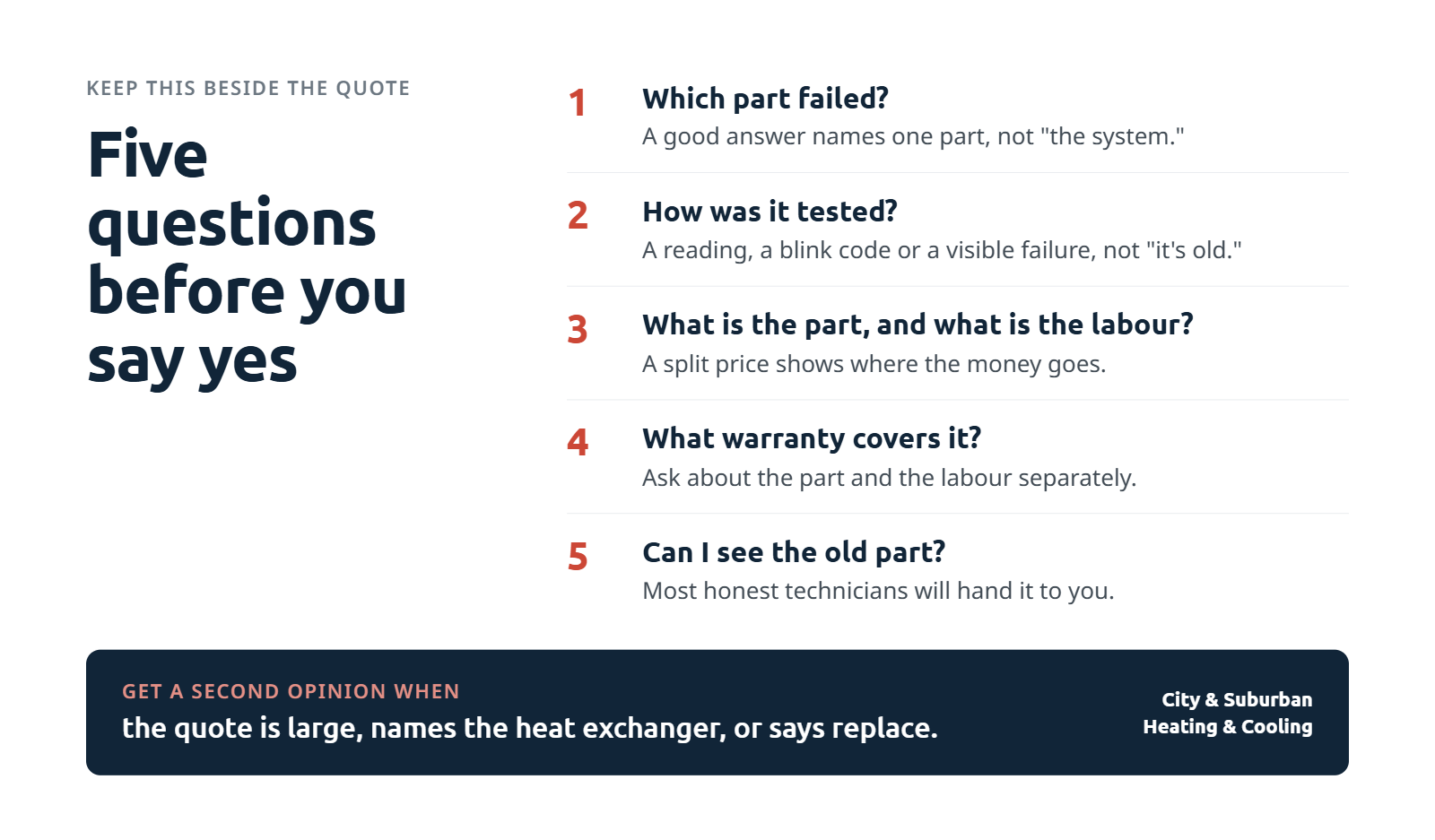
Before approving a furnace repair quote, ask five things. Which part failed, and how was it tested? What do the part and the labour each cost, what warranty covers them, and can you see the old part? Get a second opinion when the quote is large, names the heat exchanger, or says replace. City & Suburban’s reviews record second opinions where Rob found a different, cheaper fault than the first quote named.
✅ The five questions
- Which part failed? A good answer names one part, not “the system.”
- How was it tested? Look for a reading, a blink code or a visible failure, not “it’s old.”
- What is the part, and what is the labour? A split price shows where the money goes.
- What warranty covers it? Ask about the part and the labour separately.
- Can I see the old part? Most honest technicians will hand it to you.
Fire & Ice, a heating contractor, gives the same advice. A technician should explain the problem “without pressuring you,” and an itemized breakdown is a fair request [7].
⚠️ Red flags worth a second look
Watch for a quote with no test result, replace-only advice on a furnace that is not old, or pressure to sign today. Each is a reason to pause, not proof.
Quote doubt is common. One of the top Google results for blower motor cost is a Reddit thread titled “Quoted $1900 for a blower motor replacement” (r/hvacadvice). At $1,900, that quote sits just inside the national range for a variable-speed motor [2]. The motor type decides whether it is fair.
⭐ When a second opinion pays
A second opinion costs one more service call, and pays when the part is expensive or the quote says replace.
“He came in, and in half the time the other company took, told me that it was a completely different part that needed to be replaced. … His thorough and honest assessment saved us at least a couple thousand dollars of trouble shooting with the other companies.”
– Brandon A., City & Suburban Heating & Cooling Google – Verified Review
“We had City & Suburban come out for a second opinion on a furnace issue we were having. I’m so glad we did, because we ended up going with them and they were great to work with.”
– Dan H., City & Suburban Heating & Cooling Google – Verified Review
City & Suburban’s owner performs the diagnosis himself, so the person answering your five questions is the person whose name is on the business.
Q10: How can you keep furnace repair bills down?
Check the furnace filter every month, and book a heating check every fall before the first cold snap. Call at the first new noise, not after the furnace stops. ENERGY STAR recommends monthly filter checks and a yearly pre-season check-up that covers gas pressure, burner combustion and the heat exchanger [3]. City & Suburban began in 1952 with furnace cleaning, and its maintenance plans include seasonal check-ups, priority dispatch and 15% off repairs.
✅ The filter is the cheapest repair you’ll ever make
A clogged filter starves the furnace of air. The limit switch trips, the blower strains, and the heat exchanger runs hot. ENERGY STAR puts it simply: a dirty filter can damage your equipment and lead to early failure [3].
Write the filter size on the furnace in marker, and set a monthly phone reminder.
Our guide on how often to change a furnace filter has the schedule for each filter type.
⏰ Book the check before the cold
A fall check catches the cheap failures early: a dirty flame sensor, a weak capacitor, a noisy inducer bearing. In the first cold week, schedules fill and parts run short.
Teaser tune-up prices are common in Chicago searches. Whatever the price, ask what the check includes. ENERGY STAR’s list is a fair standard: connections, gas pressure, burner combustion, the heat exchanger, the condensate drain, and the start-up and shut-down cycle [3].
Our furnace tune-up cost guide shows what that check should cost in Chicago.
“I’ve been using them for several years now for annual checkups of my system and have nothing but good things to say. … No upsells, just what I need for reliable AC and heat throughout the year.”
– Eric F., City & Suburban Heating & Cooling Google – Verified Review
💰 Two habits that protect you later
Register your furnace’s warranty, and keep the model and serial numbers on your phone. When something fails, the technician can check coverage and order the right part on the first call.
City & Suburban’s maintenance plans cost $15 a month or $179 a year, and include seasonal check-ups, priority dispatch and 15% off repairs. Rob’s father started the business going door to door offering furnace cleaning, and the check-up is still where cheap repairs stay cheap.
Get a straight answer before you pay for a repair
Furnace repair cost in Chicago is mostly the price of one part and the time it takes to reach it. The national ranges in this guide tell you whether a quote is in the right world. A tested diagnosis tells you whether it is right for your furnace.
If you have a quote in hand, or no heat tonight, call Rob at (773) 238-3838. City & Suburban takes calls every day until midnight, except Sundays, and its $89 service call fee is credited toward the repair. You can also book through the Schedule Service form.
About the Author
Robert Koehler is the owner of City & Suburban Heating & Cooling, a family run heating and cooling company in Chicago. His father started the business in 1952, going door to door offering furnace cleaning across the city. Rob runs it today as the second generation.
He still performs service diagnostics himself rather than sending out a salesperson. That is how he ended up with the habit that shows up over and over in the company’s reviews: he repairs systems that other contractors have already quoted for full replacement.
City & Suburban serves Chicago and the near north and northwest suburbs. The company holds a 4.98 average on Google across 204 reviews and 4.9 on Yelp across 251 reviews. It is an American Standard dealer, and its technicians are NATE certified.
You can reach Rob directly at (773) 238-3838.
References
[1] American Standard Heating & Air Conditioning, “Average HVAC Repair Cost: Furnace, AC, and Heat Pump,” published 2 December 2024 (figures compiled with Forbes). https://www.americanstandardair.com/resources/blog/hvac-repair-cost/
[2] Filterbuy, “Furnace Blower Motor Replacement Cost Guide: Parts vs. Labor, PSC vs. ECM,” updated 19 October 2026. https://filterbuy.com/resources/furnaces/furnace-knowledge/furnace-blower-motor-replacement-cost-factors-warranty-labor-parts-psc-vs-ecm-savings/
[3] ENERGY STAR, “Maintenance Checklist,” US EPA. https://www.energystar.gov/saveathome/heating-cooling/maintenance-checklist
[4] Chicago Heat Ordinance requirements for rental units, as summarised by Koenig & Strey (KSN), 6 January 2021. https://www.ksnlaw.com/blog/chicagoheatingordinancelandlords The current rule is Section 14X-8-803 of the Municipal Code; see [8].
[5] City of Chicago, Building Permits dataset, 24 months to August 2026: 81 single-scope furnace replacement permits, median reported value $6,807. https://data.cityofchicago.org/Buildings/Building-Permits/ydr8-5enu
[6] Illinois Carbon Monoxide Alarm Detector Act, 430 ILCS 135, Sec. 10 (alarm within 15 feet of every room used for sleeping). https://ilga.gov/legislation/ilcs/documents/043001350K10.htm
[7] Fire & Ice Heating, Cooling, Plumbing & Electrical, “Furnace Repair Costs.” https://indoortemp.com/resources/furnace-repair-costs
[8] City of Chicago Department of Buildings, “Chicago Heat Ordinance” (Section 14X-8-803 of the Municipal Code: heat season September 15 to June 1; 68°F from 8:30 a.m. to 10:30 p.m. and 66°F overnight), checked November 2026. https://www.chicago.gov/city/en/depts/bldgs/supp_info/chicago-heat-ordinance.html
Customer reviews are quoted word for word from City & Suburban Heating & Cooling’s Google Business Profile, with links to each review.
FAQs
Most single-part furnace repairs are finished on the first visit. When the part has to be ordered, the fix usually lands the next day.
What decides the timing:
- Is the part on the van? Small common parts are stocked more often than brand-specific control boards or inducer assemblies.
- How fast is the diagnosis? A clear symptom and a blink code shorten it.
- Is it a cold snap? Supply houses run short of common parts in the first hard freeze.
City & Suburban's intake takes the fault description before anyone is sent, so the van can arrive with the likely part. That is the single biggest thing that turns a two-visit repair into a one-visit repair. When you call, tell us what the furnace is doing, the blink code if there is one, and the model number from the sticker inside the door.
If you have no heat now, call (773) 238-3838 or see our furnace repair service in Chicago. We take calls every day until midnight, except Sundays.
You can safely do the checks that solve a surprising share of no-heat calls. The repairs that involve gas, ignition or the control board belong with a technician.
Safe for a homeowner:
- Set the thermostat to heat, above room temperature, and replace its batteries.
- Check the furnace power switch and the breaker.
- Replace a clogged filter.
- Make sure the front panel is seated, since a loose panel stops the furnace.
- On a high-efficiency furnace, check the outdoor vent and drain for ice or snow.
Leave to a technician: igniters, flame sensors, gas valves, control boards, motors and anything near the heat exchanger. A mistake there can damage the furnace, void a parts warranty or create a gas hazard. If you smell gas, leave the house and call the gas utility from outside.
City & Suburban would rather you flip the switch back on than pay us to do it. If the checks do not bring the heat back, our furnace maintenance and repair team can diagnose it, and the $89 service call fee is credited toward the repair.
Usually not. Standard homeowners policies cover sudden, accidental damage, not parts that wear out with age. A failed igniter, motor or control board is normally treated as wear and tear.
Where coverage sometimes applies:
- Sudden events such as a fire, a lightning strike or a burst pipe that floods the furnace, depending on your policy.
- Equipment breakdown riders, which some insurers sell as an add-on.
- Home warranties, which are separate contracts with their own caps and assigned contractors.
Read your policy's exclusions, or ask your agent directly, before the furnace fails. If you hold a home warranty, check whether it lets you choose the contractor.
The cheaper protection is maintenance. A yearly check catches worn parts before they fail in a cold snap. City & Suburban's HVAC maintenance plans cost $15 a month or $179 a year and include seasonal check-ups, priority dispatch and 15% off repairs, which suits owners who want predictable costs rather than surprise bills.
Usually not for a repair. The City of Chicago Department of Buildings says repairing an existing furnace, or replacing its parts without changing what it does or lowering its efficiency, needs no building permit (checked November 2026). That covers jobs like an igniter, a motor or a control board.
What the City's rules say:
- Repairs and part swaps need no building permit. The Municipal Code exempts the repair or replacement of any part within a heating appliance that does not alter its function, in Section 14A-4-402.1 (checked November 2026).
- A complete furnace replacement generally needs a building permit. In a residential building up to four stories, the City exempts an in-kind replacement, meaning a furnace of the same type, size and shape (checked November 2026).
- Chicago Landmark properties may not get these exemptions, so check with the City first.
- Suburbs such as Skokie, Glenview and Park Ridge set their own rules, so check with the village.
The City's own page, what mechanical work does not need a building permit, lists each case, and the code text is in Section 14A-4-402.1.
Ask any contractor who will handle the permit if one is needed, and get it in writing on the quote. A replacement done without the right permit can cause problems when you sell the house.
City & Suburban pulls the permit on its furnace replacements in Chicago and schedules the inspection, so the paperwork is part of the job rather than a separate errand for you.
The parts cost the same in July as in January. What changes is everything around them: how quickly a technician can come, whether the part is in stock, and whether you are paying for an evening call because the house is cold.
Why fall and summer are easier on the budget:
- Daytime appointments are easier to get, so you avoid after-hours rates.
- Parts are in stock, so the repair is less likely to need a second visit.
- You can compare quotes without the pressure of a freezing house.
The best time to find a weak part is a fall check before the first cold snap. A dirty flame sensor, a tired capacitor or a noisy inducer bearing is a small repair in September and an emergency in January.
City & Suburban started in 1952 with furnace cleaning, and the fall check is still where cheap repairs stay cheap. Book through our Schedule Service form or read what a heating maintenance visit covers. City & Suburban's prices and lead times can change by season, so ask when you book.