Furnace Not Turning On? What to Check Before You Call

When your furnace is not turning on, the cause is usually the thermostat, a switch or breaker, the door panel, a clogged filter, or a blocked vent pipe. You can check all of those yourself in about 20 minutes, before you call anyone. Do the checks below in order, once each. If they don’t fix it, stand by the furnace and listen: what it does next tells you which part has failed.
It’s 9 p.m. in a two-flat, the thermostat says 61, and the furnace in the basement is silent. That is the kind of call City & Suburban Heating & Cooling answers all winter. I’m Rob, and I run the company my father started in 1952 cleaning furnaces door to door. I’d rather you fix it yourself tonight if you can. One safety line first: if you smell gas, leave the house now and call the gas company from outside.
A note on who is writing: City & Suburban is my company, so I have an interest when you call a contractor. Everything below works whether or not you ever call us.
Q1: What should you check first when your furnace is not turning on?
When a furnace is not turning on, check nine things in order. Start with the thermostat, the furnace switch, the circuit breaker and the door panel. Then check the air filter, the gas valve, the blinking code, and the outside vent pipes and drain. Check the flame sensor last, and only if the burners light and go out. Most homeowners can do the first eight in about 20 minutes with no tools. Carrier, Trane and Bryant all start their own troubleshooting with the same first checks [2][3][4].
| # | Check | How | Done when | Stop if |
|---|---|---|---|---|
| 1 | Thermostat | Set to Heat, 3 to 5°F above the room. Fresh batteries. No schedule or hold. | It shows it is calling for heat. | The screen stays blank with new batteries. |
| 2 | Furnace switch | A light switch on or near the furnace, often at the top of the basement stairs. | Switch is on. | – |
| 3 | Breaker | If it sits in the middle, push it fully off, then on. Once. | It stays on. | It trips again. |
| 4 | Door panel | Seat the blower door flat so it presses the safety switch. | Panel tight, tabs in slots. | – |
| 5 | Filter and registers | Replace a grey, caked filter. Open the registers. | Clean filter, arrow toward the furnace. | – |
| 6 | Gas valve | The handle on the gas pipe runs along the pipe (open). Test the stove. | Valve open, stove lights. | You smell gas. |
| 7 | Blink code | Count the flashes in the small window. Photograph it and the door chart. | Code written down. | It points to a part. |
| 8 | Vent pipes and drain | Clear snow a foot around both outside pipes. Check the pump and the pan. | Pipes clear, pan dry. | Pipes cracked or the pan keeps filling. |
| 9 | Flame sensor | Only if burners light, then die within seconds. | Burners stay lit. | You are not comfortable working with gas off. |
Checks 1 to 4: power and the call for heat
✅ The thermostat and the switch
Start at the thermostat. A schedule, a “hold” or dead batteries stop it from calling, and the furnace never hears the request. If the screen stays blank with new batteries, the problem is wiring or the furnace’s low-voltage power, and that is a call. Our thermostat repair guide covers the wiring side.
Next, find the furnace switch. It looks like a light switch, and people flip it off by accident on the way down the stairs. In a two-flat, make sure the switch you are looking at belongs to your unit’s furnace.
⚠️ The breaker and the door panel
A tripped breaker can sit in the middle position. Push it fully off, then on. Do this once: a breaker that trips again is telling you something shorted, so leave it off.
The blower door presses a small safety switch when it is seated. If the panel went back crooked after a filter change, the furnace stays dead with every other check passing.
Checks 5 to 9: air, gas and the clues
✅ Filter, gas and the code
A clogged filter makes the furnace overheat until a safety switch shuts it down [2]. Swap it, then open any closed registers. For gas, the valve handle should run along the pipe. If the stove lights, gas is reaching the house.
Before you reset anything, read the blinking light and photograph it with the chart on the door. Q3 explains why that order matters.
⏰ The outside pipes and the flame sensor
Q6 covers the outside pipes and the drain. Check 9 only applies if the burners light, then go out within seconds (Q5).
“Rob, I thank you for always being prompt when the heat goes out in the middle of the winter, when the ac crashes when it’s 100F out, or when we don’t realize that the service switch is off…”
– Sneha R., City & Suburban Heating & Cooling Google – Verified Review
City & Suburban gets calls where the whole fix is check 2, and that customer said so in public. The nine checks are free, and they are the same ones a technician starts with. If they all pass, you have saved the technician 20 minutes and narrowed the problem. Write down what you saw at each step.
Q2: Furnace has power but won’t turn on: what do the sounds and lights mean?
A gas furnace starts in a fixed order. The thermostat calls, the small inducer motor runs, and the pressure switch closes. Then the igniter glows, the gas valve opens, and the flame sensor proves the flame. The blower starts after a short delay [1]. Where the sequence stops tells you the cause. Silence points to power or the thermostat. A hum that quits points to venting. Clicking with no glow points to the igniter.
Watch a gas furnace start, one step at a time
Thermostat calls. The thermostat asks the control board for heat, and nothing in the furnace moves yet. If it stops here, the furnace stays silent. Board light off means no power (checks 2 to 4); light on or blinking means the thermostat isn't calling or a fault is stored (check 1, then read the code).
Inducer spins. The small inducer motor starts first and pulls air through the furnace and out the vent pipe. If you hear it hum and then stop, the pressure switch never closed: a blocked vent, drain or hose (check 8).
Switch closes. The pressure switch feels that draft and closes with a click. It proves the vent is clear before any gas flows. If you hear clicks but see no orange glow, suspect a cracked igniter or no gas (check 6, then one reset).
Igniter glows. The hot-surface igniter, a thin piece of ceramic, heats until it glows orange. If it glows but no flame follows, gas isn't arriving: the valve is closed or not opening (check 6, and see if the stove lights).
Flame proved. The gas valve opens, the burner lights with a soft whoosh, and the flame sensor proves the flame by passing a tiny current. If the burners light, die within seconds and retry, the sensor is usually dirty (check 9).
Blower starts. After a short delay, the big blower pulls room air through the filter and sends it back warm. If it runs a few minutes, stops and repeats, it's overheating: check the filter and registers (check 5). A blower running with no flame is still an ignition or gas fault (checks 6 to 8).
A typical gas furnace start, in the order the article gives. Your furnace's door chart has its own codes and timings, and it's the one to trust.
How to listen to a furnace start
✅ Do it with two people
Have someone turn the thermostat up three degrees while you stand at the furnace. Take a 60-second phone video through the small window in the lower door. Most furnaces show the inducer, the glow and the flame through that window.
Listen for a small motor, then a click, an orange glow and a soft whoosh of flame. The big blower comes on last.
⚠️ Where it stops is the clue
| What happens | What it usually points to | What you can do | Call when |
|---|---|---|---|
| Nothing; board light off | No power: switch, breaker, door switch, board fuse | Checks 2 to 4 | All pass and the light is still off |
| Nothing; light on or blinking | Thermostat not calling, or a stored fault | Check 1, then read the code | The code points to a part |
| Inducer hums, then stops | Pressure switch not closing: blocked vent, drain, hose | Check 8 | Pipes and drain are clear |
| Clicks, no glow, no flame | Cracked igniter, or no gas | Check 6, one reset | It repeats with gas on |
| Glows orange, no flame | Gas valve closed or not opening | Check 6 | Gas is on |
| Lights, dies in seconds, retries | Dirty or failing flame sensor | Check 9 | It locks out after cleaning |
| Runs a few minutes, stops, repeats | Overheating: filter, registers, blower | Check 5 | Clean filter, still cycling |
| Blower runs, no flame | Ignition or gas fault with the fan running | Checks 6 to 8 | Gas on, still no flame |
| Pilot out (older furnace) | Draft, dirty pilot, thermocouple | Relight once per the label | It won’t stay lit |
What the table can’t tell you
⭐ Short cycling and cold air
“Runs a few minutes, then stops” is called short cycling. It is often a dirty filter or a sensor that needs cleaning, not a dying furnace. If the burners run but the air is cold, that is a different problem with its own guide.
“Recently bought a new home and the furnace had been short cycling. Their sticker was on the furnace so I called them to come out and take a look. Turns out parts needed cleaning that stopped the short cycling issue.”
– Jessica F., City & Suburban Heating & Cooling Google – Verified Review
City & Suburban’s dispatch takes the fault description before anyone is sent, so the van arrives with the likely part. Your 60-second video and the row you landed on in that table are exactly what we ask for on the phone.
Q3: What does a blinking light on a furnace mean?
A blinking light on the furnace control board is a status code. Count the flashes through the small window in the lower door, then match them to the chart printed inside the door. Photograph both before you reset anything. On many boards, including Carrier’s red-LED controls, cutting the power erases the stored code [1].
Reading the light
✅ Where to look and how to count
Look through the sight window in the lower door. Don’t remove the board cover. A steady light or a slow, even blink usually means normal standby. A repeating pattern with a pause is a code.
Two-digit codes flash the first digit, pause, then the second. Count three full rounds, then photograph the light and the chart together.
⚠️ What the common codes mean
On one Carrier board, code 31 means the pressure switch didn’t close. The inducer then rests 15 minutes before it tries again [1]. Code 34 means the flame wasn’t proved, and code 14 means the board locked out after four failed tries [1]. Code 13 is a limit lockout, often from a dirty filter or a blocked duct [1].
Brand notes
⭐ Carrier and Bryant
Carrier and Bryant are sister brands, and many of their boards use the same two-digit codes. Still, code numbers change between board generations. Always trust the label on your own door over a chart online [1].
⭐ Goodman and American Standard
Goodman and American Standard boards use their own flash patterns. Read the code from the chart inside your own door, not from a chart for another brand.
⭐ The decision rule
- Power or limit codes: go back to checks 2 to 5.
- Pressure switch codes: go to check 8 and Q6.
- Ignition and flame codes: go to Q5.
- Any code that comes back after one reset: call, and read the code out on the phone.
“Furnace was flashing a signal and not operating as it should it -7 degree temps. They came same day and fixed the issue.”
– Travis W., City & Suburban Heating & Cooling Google – Verified Review
City & Suburban repairs all makes, so the code is the first thing we ask for, along with the brand on the rating plate. A photographed code turns “it’s not working” into a likely part before anyone drives over.
Q4: Is there a reset button on a furnace, and when should you stop resetting?
Most modern gas furnaces have no reset button. You reset one by switching it off for 10 to 30 seconds and back on, once. Control boards also lock themselves out after repeated failures and retry later: one Carrier board waits 3 hours after four failed ignitions [1]. A red button near the burners is a rollout switch. If it has popped, call.
The one reset
✅ How to do it
- Photograph the blinking code and the door chart.
- Turn the furnace switch off.
- Wait 10 to 30 seconds.
- Switch it on and watch one full start.
If it fails the same way, the fault is real, and another reset won’t fix it.
⏰ Why the furnace makes you wait
The board protects the furnace by waiting. On the Carrier label, a limit switch open for 3 minutes causes a lockout that clears itself after 3 hours [1]. A pressure switch fault rests the inducer for 15 minutes before a retry [1]. Pressing reset over and over doesn’t speed this up. It only erases the code that explained it.
The switches people find
⚠️ Can you reset the limit switch?
The main high-limit switch resets itself once the furnace cools. The job is finding why it overheated: the filter, closed registers or a weak blower. The flame rollout switch is different. It needs a manual reset because it trips when flame goes where it shouldn’t [1]. Leave it alone and call.
⭐ Why it stopped, then started again
A furnace that quits and later runs by itself has usually locked out and then retried. The fault is still there and will come back. Write the code down the next time it happens.
Older furnaces with a standing pilot are the exception. Relight the pilot once, following the label on the furnace. If it won’t stay lit, the thermocouple is the usual cause, and that is a technician job.
“My landlord was sending his guy to fix this chronic issue where it kept going out, they’d fix it, it’d go out again. … He came, identified the problem, double-checked his work and was back with the part the same night.”
– Sarah A., City & Suburban Heating & Cooling Google – Verified Review
City & Suburban’s owner does the diagnosis on service calls, and a furnace that keeps going out is exactly where that matters. A restart is a test. Finding the part that caused the lockout is the repair.
Q5: Why does a furnace click but not ignite?
A furnace that clicks but won’t ignite usually has a cracked hot-surface igniter, a pressure switch that won’t close, or no gas reaching the burners. If the burners light and then go out within seconds, the flame sensor is the usual cause. City & Suburban replaces igniters, pressure switches and flame sensors on all makes, with the price given before work starts.
What you see points to the part
✅ Match the window to the part
- Inducer runs, clicks, no orange glow: the igniter. Hot-surface igniters are thin ceramic and crack with age and heat.
- Igniter glows orange, no flame: gas. Check the valve (check 6) and whether the stove lights.
- Inducer runs, no click at all: the pressure switch hasn’t closed. Go to Q6.
- Flame for a few seconds, then out: the flame sensor.
Don’t touch a hot-surface igniter. Skin oil and small knocks crack them, and a cracked one is a replacement part.
⚠️ Not igniting, just blowing air
On many furnaces, the blower runs after failed ignition tries to clear the heat. So “it’s just blowing air” can still be an ignition or gas fault. Treat it the same way: read the code, then check gas and the vents.
The three parts that stop ignition
⭐ Goodman igniters and pressure switches
Like most modern gas furnaces, Goodman models use a hot-surface igniter and a pressure switch. The Goodman chart on the door names the flash pattern for each.
A pressure switch proves the vent is clear before gas flows. The Carrier label lists the usual reasons it won’t close [1]. They include a restricted vent, a blocked or loose pressure tube, a weak inducer, poor combustion air, and excessive wind. You can clear pipes and drains. Replacing the switch or the inducer is technician work.
⏰ The flame sensor
The flame sensor is a thin metal rod in the flame. It proves the flame is there by passing a tiny current. On the Carrier label, normal is 4.0 to 6.0 microamps, and below 0.5 the board shuts the gas off [1]. The fix on that label is cleaning the rod with fine steel wool [1].
One Carrier board retries three more times, then locks out for 3 hours [1]. That is the “lights, dies, tries again” row in Q2.
Who fixes what
💰 The decision rule
- You: clear vent pipes and drains, open the gas valve, do one reset.
- A technician: test and replace the igniter, the pressure switch, the inducer and the board, and check gas pressure.
- Tell the technician the brand and model from the rating plate, the code, and “clicks, no glow” or “glows, no flame”.
“Rob quickly diagnosed the problem, explained what was needed, went and grabbed the part and had my heat working in no time.”
– Ken D., City & Suburban Heating & Cooling Google – Verified Review
City & Suburban diagnoses before quoting, then fixes the part that failed. If your igniter is cracked, our furnace repair visits replace it with the price given upfront, and same-day visits happen when the schedule allows.
Q6: Can snow and cold stop a furnace from turning on in Chicago?
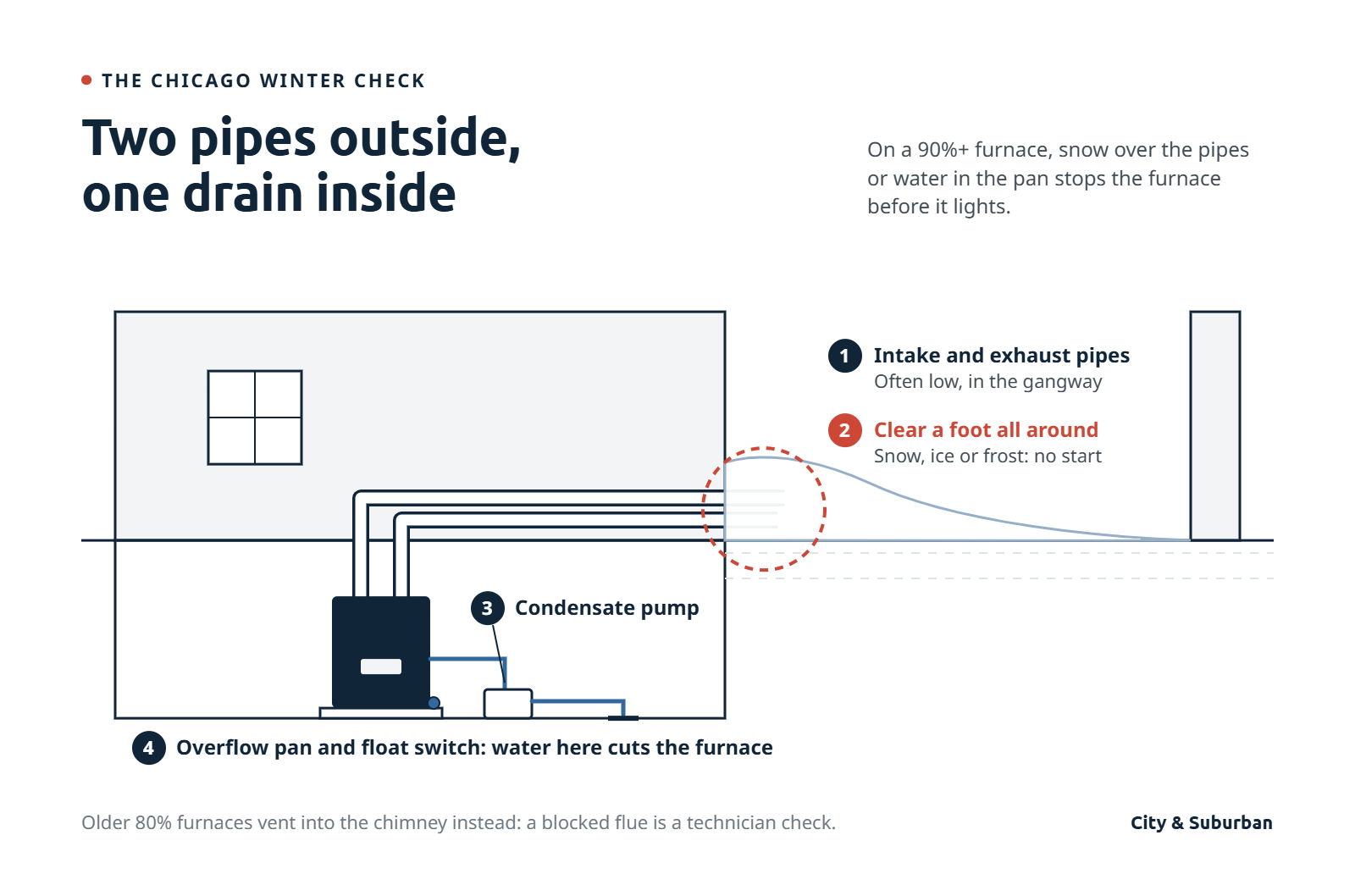
Yes. On a high-efficiency (90%+ AFUE) furnace, snow or ice over the two outside pipes stops the pressure switch closing. Then the furnace won’t light. A frozen condensate line, or water in the overflow pan, does the same through a float switch. Clearing them is often the whole fix. The Carrier label lists “restricted vent” and “excessive wind” as pressure switch causes [1].
Where to look on a Chicago house
✅ Find the two pipes
On a 90%+ furnace, two white or grey plastic pipes leave the basement through an outside wall. On a Chicago bungalow or two-flat, they often come out low, into the gangway or by the back stairs. That is where drifts pile up and roof snow lands.
- Clear snow a foot all around both pipes.
- Knock off ice gently. Look inside the exhaust end for frost.
- Go back inside and do one reset (Q4).
⚠️ Wind and frost
A hard wind across a side-wall vent can also stop the pressure switch [1]. Frost can build inside the exhaust end on a sub-zero night. If the pipes look clear and it still won’t light, call.
Water inside the house
⏰ The drain, the pump and the pan
High-efficiency furnaces make water. It runs through a trap to a floor drain or a small condensate pump. A drain line routed outside or through a cold space can freeze. A full pump, or water in the overflow pan, trips a float switch that cuts the furnace.
- Empty the pump reservoir, or unplug it and plug it back in.
- Dry the overflow pan.
- Warm an indoor line that froze. Never use an open flame.
⭐ Older furnaces and the chimney
Older 80% furnaces vent into the chimney instead of plastic pipes. A blocked flue trips the pressure switch in the same way. That is a technician check, not a homeowner job.
“When I needed him recently to check my furnace due to water leaks related to a clogged condensation pipe above my condo unit he came out right away…”
– Larry V., City & Suburban Heating & Cooling Google – Verified Review
City & Suburban works on pre-war Chicago housing every winter: bungalows, two-flats and greystones with vents in tight gangways.
Q7: When should you stop troubleshooting, and what do you do tonight?
Stop and call when you smell gas, a carbon monoxide alarm sounds, you smell burning, or you hear banging. Also call when the breaker trips twice, the rollout switch has tripped, or the same code returns after one reset. And call if all nine checks pass and it still won’t start. City & Suburban covers emergencies every day until midnight, except Sundays, at (773) 238-3838.
The stop list
❌ Leave first, then call
- Gas smell: leave the house, then call from outside. In Chicago, Peoples Gas: 866-556-6002 [6]. In the suburbs, call the utility on your bill; Nicor Gas’s 24-hour line is 888-642-6748 [7].
- Carbon monoxide alarm: get everyone out and call 911 [6]. Illinois law requires working CO alarms in homes, so test yours.
- Burning plastic or electrical smell, banging or screeching: switch the furnace off and call.
⚠️ Leave it off and call
- The breaker trips a second time.
- The rollout switch has popped (Q4).
- The same code returns after one reset.
- Water keeps pooling around the furnace.
What to have ready
✅ Five things for the phone
- Brand and model from the rating plate inside the door.
- Roughly how old the furnace is.
- The blinking code and your photo of it.
- What you heard (the Q2 table row).
- Which of the nine checks you already did.
“He came in, and in half the time the other company took, told me that it was a completely different part that needed to be replaced.”
– Brandon A., City & Suburban Heating & Cooling Google – Verified Review
That is why the diagnosis matters more than the part. Call City & Suburban at (773) 238-3838. Rob or Eddie cover after-hours calls every day until midnight, except Sundays. Same-day visits happen when the schedule allows. You can also schedule service online.
“I called on a Sunday night because my furnace wasn’t working. The repair person was here first thing on Monday morning.”
– Russell K., City & Suburban Heating & Cooling Google – Verified Review
Tonight, while you wait
⭐ Keep the house and pipes safe
Close off unused rooms and keep doors to the furnace room open. Open the cabinet doors under sinks on outside walls. Use space heaters only as their labels allow, and never heat with an oven or a grill.
⭐ Renters and two-flat owners
Chicago’s Heat Ordinance runs from September 15 to June 1. Where the landlord supplies heat, rooms must reach 68°F from 8:30 a.m. to 10:30 p.m., and 66°F overnight [5]. Where a unit has its own furnace, the owner must keep it working and able to hold 68°F [5]. Stoves and portable space heaters don’t count toward the minimum [5]. Tell the landlord in writing, and call 311 if it isn’t fixed [5].
“Our HVAC technician responded to my text at 10:00 PM the night before the coldest day of the year… he restored heat quickly so our tenant could remain safe and comfortable in freezing temperatures.”
– Lone W., City & Suburban Heating & Cooling Google – Verified Review
City & Suburban works for small landlords with two-flats and three-flats, where a dead furnace is a tenant’s problem and an ordinance problem at once.
Q8: How much does it cost to fix a furnace that won’t turn on?
Most no-start repairs are small parts: an igniter, a flame sensor cleaning, a pressure switch, or a thermostat. The bigger ones are an inducer motor or a control board. City & Suburban’s service call fee is $89, plus $75 after hours, and it is credited toward the repair. Before you replace a whole furnace, run the $5,000 rule below.
What the common repairs cost
💰 The common no-start repairs
| Repair | What it fixes |
|---|---|
| Thermostat repair or replacement | No call for heat |
| Hot-surface igniter | Clicks, no glow |
| Flame sensor clean or replace | Lights, then goes out |
| Pressure switch | Inducer runs, no ignition |
| Inducer motor | Hum, no start, noise |
| Control board | Dead board, odd codes |
Average repair prices you see online come mostly from contractor marketing pages, not from a dataset. Our furnace repair cost guide shows what the repair costs part by part, and where each published range comes from.
Repair or replace?
💸 The $5,000 rule
Multiply the furnace’s age by the repair cost. If the answer is over $5,000, price a replacement alongside the repair. The rule is a contractor rule of thumb, not a standard. It is a fair place to start the conversation.
- A 10-year-old furnace with a $300 repair: 10 × 300 = 3,000. Repair it.
- An 18-year-old furnace with a $450 repair: 18 × 450 = 8,100. Price both.
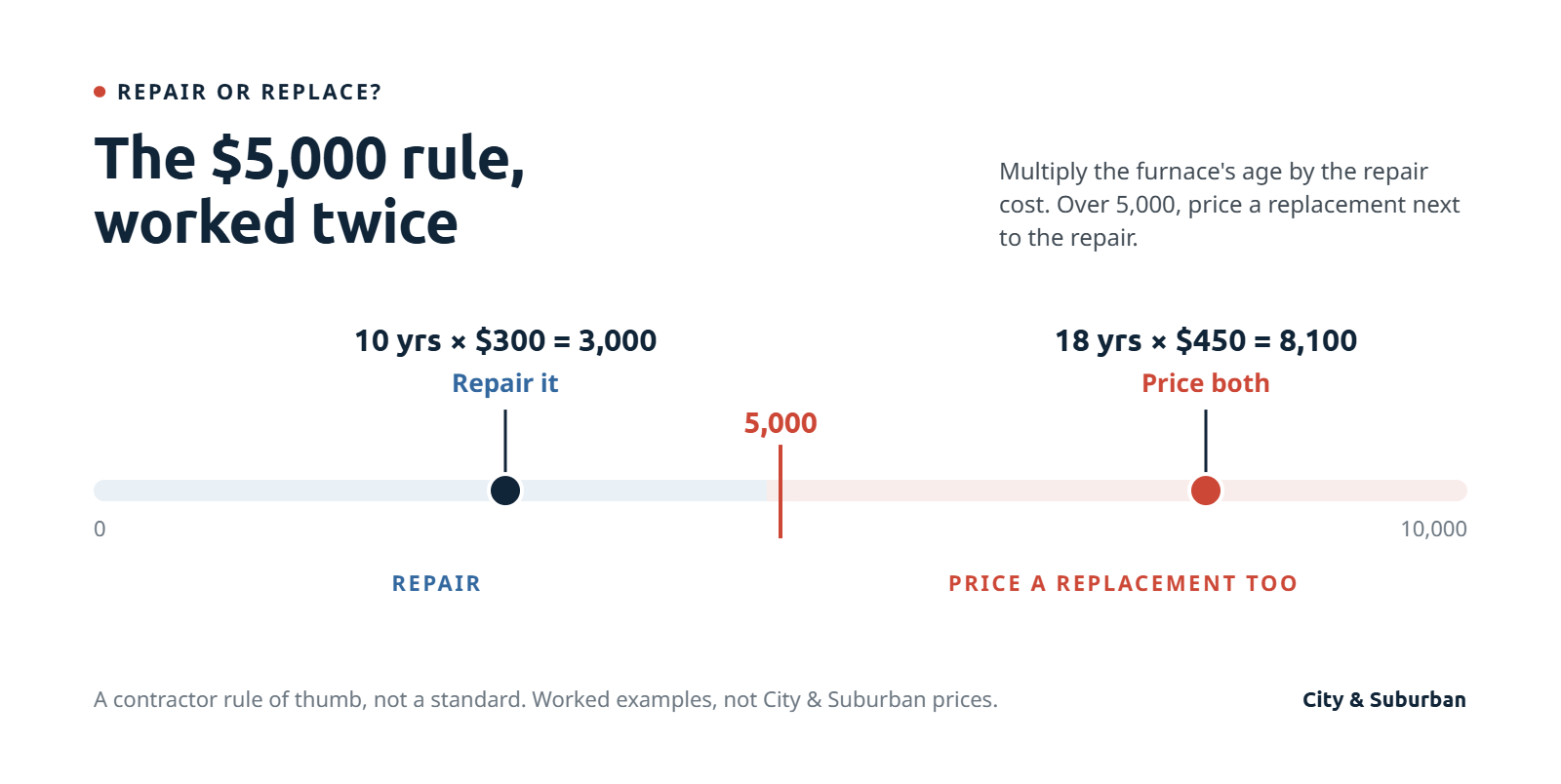
Those two repair amounts are worked examples, not City & Suburban prices. To judge how much life is left, our guide to how long furnaces last shows how to date your furnace.
⭐ When you do replace
If replacement makes sense, City & Suburban gives free estimates. Our furnace installation work includes Wells Fargo financing for those who want it.
“Rob came by and said the motor was on its last leg – he said we could replace the motor or the whole furnace and gave us pricing for both.”
– Mardi K., City & Suburban Heating & Cooling Google – Verified Review
City & Suburban’s owner does the diagnosis and is not paid more if the answer is replacement. That is why customers get the repair price and the replacement price side by side, and choose.
Q9: How do you stop a furnace from failing to turn on next winter?
Have the furnace serviced once a year before the heating season. A tune-up checks most of the parts that stop a furnace from starting. That means the igniter, the flame sensor, the pressure switch hose, and the condensate trap and drain. Between visits, change the filter on schedule and keep the outside vent pipes clear. City & Suburban started in 1952 as a furnace-cleaning business.
The October list
✅ Five things before the first cold night
- Book the tune-up for early fall, before the first cold snap.
- Put in a new filter and note the date on it.
- Change the thermostat batteries.
- Run the heat for a full cycle on a mild day.
- Mark where the vent pipes are, so you can find them under snow.
⏰ Why fall, not January
A limping furnace often fails on the first long cold night, when it runs nonstop. Finding a weak igniter on a mild day costs an appointment, not a night without heat.
What a tune-up checks
⭐ The parts behind no-start calls
A tune-up should include cleaning and testing the flame sensor. The Carrier label’s normal reading is 4.0 to 6.0 microamps [1]. It should also check the igniter, the pressure switch and its hose, the condensate trap and drain, and the filter.
On a City & Suburban tune-up, the flame sensor is cleaned and tested every time. The technician writes down five readings: flame signal, gas pressure, flue CO, temperature rise and static pressure. A standard 1-inch filter is included, and the technician labels the filter size on the furnace. The tune-up is $149 for one gas furnace.
💰 Plans and priority
City & Suburban’s maintenance plans include seasonal check-ups, priority dispatch and member discounts. For a single visit, see our furnace maintenance page or the heating maintenance guide. Our furnace tune-up cost guide explains what that visit includes, and our guide on how often to change a furnace filter covers the one job you can do yourself.
“We wanted to make sure everything was running smoothly before winter and after calling Rob, he was able to come out very quickly.”
– Austin H., City & Suburban Heating & Cooling Google – Verified Review
City & Suburban still does what the business was founded on: cleaning and checking furnaces before Chicago winters. A fall visit is the cheapest way to avoid the 9 p.m. call.
Still no heat?
If you have worked through the nine checks and the furnace still won’t turn on, call City & Suburban at (773) 238-3838. Have the code, the brand and what you heard ready. Rob, Eddie or Carissa will take it from there. You can also schedule service online, or read how we approach furnace service first.
References
[1] Carrier, 58MCB gas furnace status code label (service label copy), “Status codes 11 to 45”. https://www.manualsdir.com/manuals/60520/carrier-58mcb.html?page=18
[2] Carrier, “Your Guide To A Furnace Not Turning On”. https://www.carrier.com/us/en/residential/hvac-resources/furnaces/furnace-not-turning-on/
[3] Trane, “Furnace Troubleshooting: 7 Gas Furnace Solutions”. https://www.trane.com/residential/en/resources/troubleshooting/gas-furnaces/
[4] Bryant, “Why Is My Furnace Not Turning On?”. https://www.bryant.com/en/us/products/gas-furnaces/furnace-not-turning-on/
[5] City of Chicago Department of Buildings, “Chicago Heat Ordinance” (Municipal Code 14X-8-803). https://www.chicago.gov/city/en/depts/bldgs/supp_info/chicago-heat-ordinance.html
[6] Peoples Gas, “Emergencies”. https://www.peoplesgasdelivery.com/safety/emergency
[7] Nicor Gas, “Emergency Information”. https://www.nicorgas.com/safety/emergency-information.html
[8] Verified customer review (Sneha R.), Google Business Profile, City & Suburban Heating & Cooling, March 2022. https://www.google.com/maps/reviews/data=!4m8!14m7!1m6!2m5!1sChdDSUhNMG9nS0VJQ0FnSURXd0xUTWtRRRAB!2m1!1s0x0:0xb1c6abfab8cf849b!3m1!1s2@1:CIHM0ogKEICAgIDWwLTMkQE%7C%7C?hl=en
[9] Verified customer review (Jessica F.), Google Business Profile, City & Suburban Heating & Cooling, November 2025. https://www.google.com/maps/reviews/data=!4m8!14m7!1m6!2m5!1sCi9DQUlRQUNvZENodHljRjlvT2tkTFEwcDNVVFpKUVROdk1GUTNTRlpvTmprdGNHYxAB!2m1!1s0x0:0xb1c6abfab8cf849b!3m1!1s2@1:CAIQACodChtycF9oOkdLQ0p3UTZJQTNvMFQ3SFZoNjktcGc%7C%7C?hl=en
[10] Verified customer review (Travis W.), Google Business Profile, City & Suburban Heating & Cooling, January 2026. https://www.google.com/maps/reviews/data=!4m8!14m7!1m6!2m5!1sCi9DQUlRQUNvZENodHljRjlvT2podGRHOWhZWE52V2pBNWJ6ZEpXSGQ1V0VoR09IYxAB!2m1!1s0x0:0xb1c6abfab8cf849b!3m1!1s2@1:CAIQACodChtycF9oOjhtdG9hYXNvWjA5bzdJWHd5WEhGOHc%7C%7C?hl=en
[11] Verified customer review (Sarah A.), Google Business Profile, City & Suburban Heating & Cooling, March 2024. https://www.google.com/maps/reviews/data=!4m8!14m7!1m6!2m5!1sChZDSUhNMG9nS0VJQ0FnSUNENllqUEpREAE!2m1!1s0x0:0xb1c6abfab8cf849b!3m1!1s2@1:CIHM0ogKEICAgICD6YjPJQ%7C%7C?hl=en
[12] Verified customer review (Ken D.), Google Business Profile, City & Suburban Heating & Cooling, April 2026. https://www.google.com/maps/reviews/data=!4m8!14m7!1m6!2m5!1sCi9DQUlRQUNvZENodHljRjlvT2pOVFNHdHpWalZQTm14T2QwSnhXbmRDWVdOaFIxRRAB!2m1!1s0x0:0xb1c6abfab8cf849b!3m1!1s2@1:CAIQACodChtycF9oOjNTSGtzVjVPNmxOd0JxWndCYWNhR1E%7C%7C?hl=en
[13] Verified customer review (Larry V.), Google Business Profile, City & Suburban Heating & Cooling, July 2025. https://www.google.com/maps/reviews/data=!4m8!14m7!1m6!2m5!1sCi9DQUlRQUNvZENodHljRjlvT20xeVUyOTRiMUUwV2w5dVgwMWFlVlZUZW5VMmRYYxAB!2m1!1s0x0:0xb1c6abfab8cf849b!3m1!1s2@1:CAIQACodChtycF9oOm1yU294b1E0Wl9uX01aeVVTenU2dXc%7C%7C?hl=en
[14] Verified customer review (Brandon A.), Google Business Profile, City & Suburban Heating & Cooling, January 2023. https://www.google.com/maps/reviews/data=!4m8!14m7!1m6!2m5!1sChdDSUhNMG9nS0VJQ0FnSURCdE5yMnh3RRAB!2m1!1s0x0:0xb1c6abfab8cf849b!3m1!1s2@1:CIHM0ogKEICAgIDBtNr2xwE%7C%7C?hl=en
[15] Verified customer review (Russell K.), Google Business Profile, City & Suburban Heating & Cooling, March 2026. https://www.google.com/maps/reviews/data=!4m8!14m7!1m6!2m5!1sCi9DQUlRQUNvZENodHljRjlvT20xVlVXRjZlRmhGWkZGRldWVkdXWFZUYVdwaE9FRRAB!2m1!1s0x0:0xb1c6abfab8cf849b!3m1!1s2@1:CAIQACodChtycF9oOm1VUWF6eFhFZFFFWVVGWXVTaWphOEE%7C%7C?hl=en
[16] Verified customer review (Lone W.), Google Business Profile, City & Suburban Heating & Cooling, January 2026. https://www.google.com/maps/reviews/data=!4m8!14m7!1m6!2m5!1sCi9DQUlRQUNvZENodHljRjlvT2xGVFFsRllVa05aWW1sNlkzWnNaVTVTVjJsdWNXYxAB!2m1!1s0x0:0xb1c6abfab8cf849b!3m1!1s2@1:CAIQACodChtycF9oOlFTQlFYUkNZYml6Y3ZsZU5SV2lucWc%7C%7C?hl=en
[17] Verified customer review (Mardi K.), Google Business Profile, City & Suburban Heating & Cooling, February 2026. https://www.google.com/maps/reviews/data=!4m8!14m7!1m6!2m5!1sCi9DQUlRQUNvZENodHljRjlvT2pSaFkxUXpNVEl0WlRKU2NYaFBNbFoyUkRobmJtYxAB!2m1!1s0x0:0xb1c6abfab8cf849b!3m1!1s2@1:CAIQACodChtycF9oOjRhY1QzMTItZTJScXhPMlZ2RDhnbmc%7C%7C?hl=en
[18] Verified customer review (Austin H.), Google Business Profile, City & Suburban Heating & Cooling, November 2024. https://www.google.com/maps/reviews/data=!4m8!14m7!1m6!2m5!1sChdDSUhNMG9nS0VJQ0FnSUNQb0xTcTRnRRAB!2m1!1s0x0:0xb1c6abfab8cf849b!3m1!1s2@1:CIHM0ogKEICAgICPoLSq4gE%7C%7C?hl=en
About the Author
Robert Koehler is the owner of City & Suburban Heating & Cooling, a family run heating and cooling company in Chicago. His father started the business in 1952, going door to door offering furnace cleaning across the city. Rob runs it today as the second generation.
He still performs service diagnostics himself rather than sending out a salesperson. That is how he ended up with the habit that shows up over and over in the company’s reviews: he repairs systems that other contractors have already quoted for full replacement.
City & Suburban serves Chicago and the near north and northwest suburbs. The company holds a 4.98 average on Google across 204 reviews and 4.9 on Yelp across 251 reviews. It is an American Standard dealer, and its technicians are NATE certified.
You can reach Rob directly at (773) 238-3838.
FAQs
After a power outage, a furnace usually needs one clean restart, and sometimes a part has been damaged by the surge when power came back.
- Check the furnace switch and the breaker first. A surge can trip the breaker.
- Switch the furnace off for 10 to 30 seconds, then on, once.
- Look at the control board light through the small window. If it is completely dark and the switch and breaker are fine, the board's low-voltage fuse or the board itself may have failed.
Brownouts during Chicago storms are the harder case. A furnace can lock itself out after several failed starts at low voltage, then wait before it tries again. Write down any blinking code before you reset, because cutting the power can erase it.
City & Suburban's advice after a storm is simple. If one restart doesn't bring the heat back, the problem is a part, not the restart. Our furnace repair team will test the board, the fuse and the transformer and give you the price before any work starts. Have the brand, the code and what you heard ready when you call.
The most common reason a furnace won't start right after a filter change is the blower door. It presses a small safety switch, and if the panel goes back crooked, the furnace stays off.
- Take the lower panel off and put it back flat, with the tabs in their slots and the latch closed.
- Check the filter's arrow points toward the furnace, in the direction of airflow.
- Make sure the filter is the right size and isn't bent into the slot.
- Check you didn't switch the furnace off at the service switch while you worked.
A filter that is too restrictive, or one jammed in sideways, can also make the furnace overheat and shut down on its limit switch after a few minutes. That looks like a furnace that starts, runs briefly, then stops.
City & Suburban has had calls where the whole fix was the service switch, and we would rather you check the simple things first. If the panel is seated and the furnace still won't start, read the blinking code and see our guide to heating maintenance for the filter side, or call us.
If your air conditioning runs but the furnace won't heat, the power, the thermostat wiring and the blower are probably fine. The AC uses the same thermostat and the same blower, so the fault is on the heating side.
- Check the thermostat is set to Heat, not Cool or Auto with a cooling schedule.
- Check the gas valve at the furnace is open, with the handle running along the pipe.
- Watch a start: does the small inducer motor run, does the igniter glow, does a flame light?
- Read the blinking code on the control board.
The usual causes are a cracked igniter, a pressure switch that won't close because of a blocked vent or drain, or a dirty flame sensor. In the fall, the first heating cycle of the year often shows up a part that weakened over the summer.
City & Suburban works on both heating and cooling, so we can test the whole system in one visit. Book a furnace tune-up before the first cold night, or call if the heat is already out.
When a furnace stops working right after a thermostat change, the cause is almost always the thermostat's wiring or settings, not the furnace.
- Missing C wire: many smart thermostats need a common (C) wire for constant power. Without it, they can drop out or fail to call for heat.
- Wrong system type: a thermostat set up for a heat pump or electric heat won't run a gas furnace correctly. Check the installer settings.
- Loose or swapped wires: the W wire calls for heat. If it isn't seated, nothing happens.
- Blown board fuse: a wire touching the wrong terminal during the swap can blow the small fuse on the furnace control board.
Switch the furnace off before touching thermostat wires. If the screen is blank with fresh batteries, or the board light on the furnace is dark, stop there and call.
City & Suburban fixes thermostat wiring as part of a furnace service call. Our thermostat repair guide covers the common wiring problems in more detail.
A furnace that won't start on the first cold day has usually been sitting for months, and something changed over the summer.
- The thermostat is still on Cool, or a schedule is holding it down.
- The gas valve or the furnace switch was turned off for summer work and never turned back on.
- On older furnaces with a standing pilot, the pilot was left out.
- Dust built up on the flame sensor, so the burners light and then shut off within seconds.
- A spider or a nest blocked the outside vent pipe or the condensate drain.
Run checks 1, 2, 6 and 8 from the list above, then watch one full start. If it lights and goes out, the flame sensor is the usual cause, and cleaning it is part of a tune-up.
City & Suburban began in 1952 as a furnace-cleaning business, and a fall check is still the cheapest way to avoid this call. Our maintenance plans include seasonal check-ups and priority dispatch. If it is already cold, call us at (773) 238-3838.