Furnace Tune-Up Cost: What You Pay For in Chicago

Picture a two-flat owner in Logan Square in September, holding two postcards. One offers a furnace tune-up for $49. The other says $149. Both say “tune-up,” and the furnace in the basement works fine, so why pay three times as much?
A furnace tune-up cost in Chicago usually runs about $90 to $150 for one gas furnace. Coupon visits at $49 to $89 tend to skip the combustion and gas-pressure tests. The full price should buy a written sheet of readings. The best time to book is September or early October. This guide covers what each price buys, how to compare offers, and when a plan is cheaper.
Q1: How much does a furnace tune-up cost in Chicago?
Most Chicago homeowners pay about $90 to $150 for a full tune-up on one gas furnace, based on published 2026 Chicago offers [8]. Coupon visits run $49 to $89 per furnace and usually exclude the filter and any repairs [9][10]. A second furnace, a humidifier pad, or a new filter adds to the bill. City & Suburban’s own price for one gas furnace is $149.
⚠️ A disclosure before the numbers
City & Suburban sells furnace tune-ups, and I own it, so read my numbers with that in mind. I’ll show where each figure comes from, and I’ll say when a cheaper visit is fine.
Every price range online, including the ones Google repeats, traces back to contractor pages and price aggregators [7][8][11]. None comes from an independent dataset. Treat them as published offers, and check the date.
💰 What Chicago tune-ups cost in 2026
| Price line | Chicago range | City & Suburban |
|---|---|---|
| Coupon or promo tune-up | $49 to $89 per furnace | – |
| Full tune-up, one gas furnace | About $90 to $150; one 35-point service lists $139.95 | $149 |
| Maintenance plan | $150 to $500 a year, about $10 to $30 a month | $15 a month or $179 a year, with 15% off repairs |
| Filter, humidifier pad, repairs | Usually extra | Standard 1-inch filter included |
💸 What moves the price
Two furnaces cost more than one. That matters in a two-flat, or in a house with an upstairs unit. A high-efficiency 90%+ furnace adds a condensate drain and trap to flush. A filter you forgot to buy gets added at the technician’s price.
Timing matters too. A planned tune-up is a flat price. A breakdown on a January night is billed by the hour. Chicago contractors list after-hours labor at roughly $140 to $215 an hour [8]. Booking ahead keeps you on the flat price.
Does the type of furnace change the price?
Yes. Gas furnaces, which most Chicago homes have, cost more to tune up than electric ones because of the combustion and gas checks [8]. Oil furnaces cost the most, but they’re rare in the city. Boilers and radiators are a different service, which City & Suburban handles through its boiler service.
One City & Suburban customer with two furnaces described the visit like this:
“I called City & Suburban Heating to have my furnaces cleaned. They told me that Rob was going out of town for a week. I asked he could come before he left, and he came two days after my call. I had forgotten to buy a furnace filter for one of the furnaces, but luckily he had it in his truck. He is very reliable and does a great job.”
– Susan N., November 2025, City & Suburban Google – Verified Review
City & Suburban discloses its service call fee up front and credits it toward any repair the visit turns up. Before booking any furnace maintenance in Chicago, ask for the tune-up price per furnace, and ask whether the filter is included. City & Suburban’s $149 tune-up includes a standard 1-inch filter, and the technician labels the filter size on the furnace.
Q2: What does a furnace tune-up include?
A full furnace tune-up cleans the burners and flame sensor and tests every safety switch. It also measures gas pressure, combustion and carbon monoxide, venting, temperature rise, airflow, and motor current. ENERGY STAR names gas pressure, burner combustion, and the heat exchanger as the contractor’s heating checks [1]. The visit should end with a written sheet of readings.
✅ The public baseline
ENERGY STAR’s maintenance checklist is a good yardstick because it isn’t selling anything. For heating, it lists gas connections, gas pressure, burner combustion, and the heat exchanger. For every system, it adds thermostat settings, electrical connections, motor voltage and current, the condensate drain, and the start-up and shutdown cycle [1].
Ads talk about “21-point” or “35-point” inspections. Count what gets measured, not the number of points. A long list of things looked at is not the same as five numbers written down.
✅ The checks, in the order a technician works
| # | Check | What the technician does | What should be on your sheet |
|---|---|---|---|
| 1 | Thermostat | Starts a heating cycle and watches start-up | Starts on call; any error code |
| 2 | Air filter | Checks size and condition, replaces if supplied | Filter size and rating |
| 3 | Igniter and burners | Inspects the igniter, cleans the burners | Igniter condition; even blue flame |
| 4 | Flame sensor | Cleans the rod and measures its signal | Microamp reading |
| 5 | Gas pressure | Measures inlet and manifold pressure | Pressure vs rating plate |
| 6 | Combustion and CO | Runs a combustion analyzer in the flue | CO (ppm), oxygen, efficiency |
| 7 | Venting and draft | Checks flue pipe, chimney, or PVC vents | Draft pass; vent condition |
| 8 | Heat exchanger | Inspects with a light or camera | Inspected; any finding, with photo |
| 9 | Blower | Checks wheel, motor amps, and capacitor | Amps and capacitor vs labels |
| 10 | Temperature rise | Supply air minus return air | Degrees vs rating plate range |
| 11 | Static pressure | Measures duct pressure across the furnace | Reading vs maker’s limit |
| 12 | Safety controls | Tests high limit, rollout, and pressure switch | Each pass or fail |
| 13 | Condensate (90%+) | Flushes trap and drain, checks pump | Drain clear; pump working |
| 14 | Electrical | Tightens connections, checks voltage | Pass; anything loose |
| 15 | CO alarms | Tests the alarm near the furnace and bedrooms | Present and working |
| 16 | Humidifier | Checks pad, drain, and setting | Pad replaced (often extra) |
Check 4 is the one most no-heat calls trace back to. Our guide to flame sensor cleaning explains what the microamp reading means.
⭐ Older and newer Chicago furnaces need different checks
An 80% furnace in an older bungalow often vents into a masonry chimney shared with the water heater, so the draft check matters most. If that chimney is crumbling or unlined, it needs its own chimney repair visit. A 90%+ furnace vents through PVC pipe and drains water, so the condensate trap and the outside pipe ends matter most. A good tune-up adjusts to the furnace in front of it.
One customer put it plainly:
“Robert is the best. Unlike some other techs you actually feel like your unit was serviced. He takes time to explain as well and is patient in checking the system or addressing items that need cleaning”
– a a. (name as shown on Google), September 2025, City & Suburban Google – Verified Review
City & Suburban’s NATE-certified technicians work from a written tune-up sheet, and you can ask for a copy at the end of the visit. On every tune-up, the technician cleans and tests the flame sensor and writes down all five readings covered in Q4.
Q3: Why do some furnace tune-ups cost $49 and others $200?
Furnace tune-ups priced at $49 to $89 are usually a basic inspection: cleaning and a look. They skip the combustion test, gas pressure, temperature rise, and static pressure. A full tune-up at $130 to $200 pays for the instruments and the technician’s time. The quickest test is to ask whether readings come back in writing.
❌ Same name, different product
“Tune-up” isn’t a defined term. One published Chicago offer is $49 per furnace, valid for homes only, with filter and repairs subject to extra charges [9]. Another is $89 with a free carbon monoxide check [10]. A 35-point service lists $139.95 [8].
These aren’t dishonest prices. They’re different products sold under one word. The coupon visit is built to be quick, and the full visit is built to measure.
⚠️ What the cheap visit usually leaves out
| What you get | Typical promo visit | Full tune-up |
|---|---|---|
| Burners and flame sensor cleaned | Often | Yes |
| Combustion and CO in the flue measured | Rarely | Yes |
| Gas pressure measured | Rarely | Yes |
| Temperature rise and static pressure | Rarely | Yes |
| Readings in writing | Rarely | Yes |
| Price per furnace, filter extra | Usually | Varies |
Google’s own answer for this search warns about high-pressure selling on promotional inspections. A low price is usually paid back through a repair found on the visit.
⏰ Questions to ask on the phone
Before booking any tune-up, ask these five questions:
- Is the price per furnace, and what does a second furnace cost?
- Will you run a combustion test and check the gas pressure?
- Will I get the readings in writing?
- Is the filter included, and what size should I have ready?
- Is anything else extra, such as a humidifier pad?
If two offers measure the same things, take the cheaper one. If the cheap one doesn’t measure, you’re comparing a look with a test. My own rule is simple: I’d pay for the visit that measures.
City & Suburban’s owner runs the diagnostics himself, so there’s no commission tied to finding a repair. City & Suburban also offers free estimates on any repair the visit uncovers.
Q4: What readings should you get after a furnace tune-up?
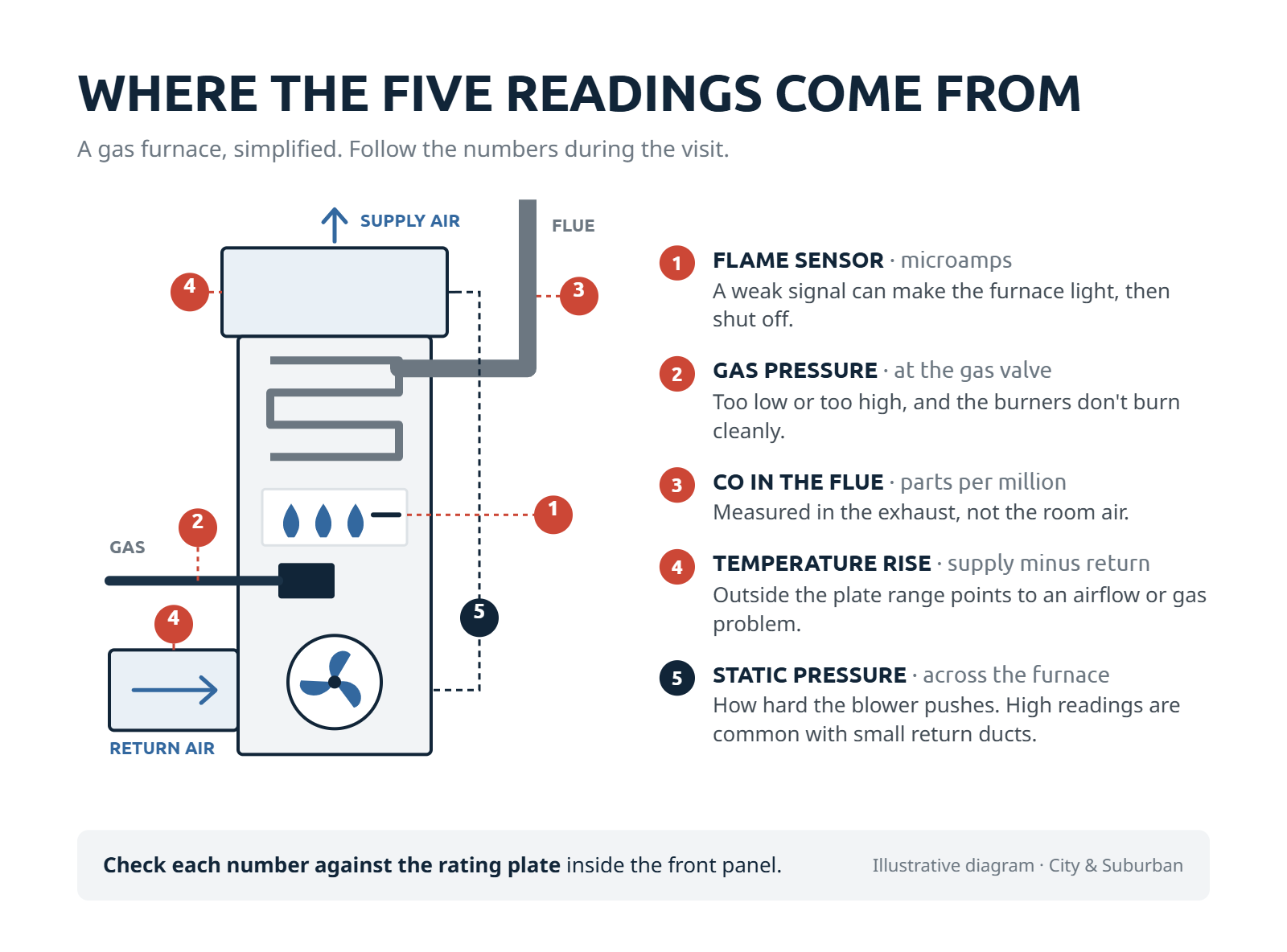
A tune-up sheet should show five numbers, not ticks: flame sensor signal, gas pressure, carbon monoxide in the flue, temperature rise, and static pressure. Each sits next to the range printed on the furnace’s rating plate.
✅ The five numbers and what they tell you
- Flame sensor (microamps): a weak signal means the furnace may light, then shut off. Cleaning usually fixes it.
- Gas pressure (inches of water column): too low or too high, and the burners don’t burn cleanly [1].
- CO in the flue (parts per million): shows how cleanly the furnace burns. It’s measured in the exhaust, not the room.
- Temperature rise (degrees F): supply air minus return air. Outside the plate range points to an airflow or gas problem.
- Static pressure (inches of water column): how hard the blower pushes against the ducts. High readings are common with small return ducts.
⭐ Where to find your allowed range
Every furnace has a rating plate inside the front panel. It lists the allowed temperature rise and the gas pressure. A good technician writes the reading next to that range, so you can see the gap yourself. Keep the sheet; it’s your record for next year and for any warranty claim.
How temperature rise shows an airflow problem
Two thermometers. Room air comes back cool through the return duct, crosses the hot heat exchanger and leaves warmer as supply air. A technician reads a thermometer in each duct. Supply minus return is the temperature rise, one of the five numbers your tune-up sheet should show.
Good airflow. With a clean filter and open vents, plenty of air crosses the heat exchanger and carries the heat away. The rise lands inside the range on the furnace's rating plate, which sits inside the front panel. A good technician writes the reading next to that range.
Restricted airflow. A dirty filter or closed vents cut the air, but the burners still make the same heat, so less air leaves much hotter. The rise climbs past the plate range and the heat exchanger runs hot. A rise outside the range points to an airflow or gas problem.
Limit trips. When the heat exchanger gets too hot, the high-limit switch opens and shuts off the burners, then resets as the blower cools it, and the burners relight. That's short-cycling: the furnace starts and stops every few minutes. A $49 to $89 visit that skips the temperature-rise reading can miss it, because the furnace still lights and blows warm air.
All temperatures here (68°F return air, 118°F and 142°F supply air) and the 35–65°F range are examples. Your furnace's own rating plate sets its allowed temperature rise.
City & Suburban’s technicians write all five readings on the tune-up sheet every time: flame signal, gas pressure, flue CO, temperature rise, and static pressure.
Q5: Is a furnace tune-up worth it?
For a gas furnace, a yearly tune-up is worth it, mainly for the safety tests: combustion, carbon monoxide, venting, and gas pressure. It also catches a dirty flame sensor or blocked drain before the first cold night. It matters less for an electric furnace or one being replaced this season. Many manufacturer warranties also expect documented yearly maintenance.
⚠️ “Isn’t it just a filter change?”
A long r/hvacadvice thread asks exactly this: are furnace tune-ups worth it, or only when something’s wrong [6]? It’s a fair doubt. If you change your own filter and the furnace runs, a quick look adds little.
The value of a real tune-up is the measurements, not the dusting. You can’t see gas pressure or flue carbon monoxide from the basement stairs. A sheet of readings also gives you a baseline, so next year’s technician can spot a change.
💰 The warranty question
Contractor pages often say a tune-up protects your warranty, and that many warranties cover parts only when maintenance is done yearly [12]. That claim comes from contractor marketing, not from one rule that covers every brand. Read your own warranty paperwork, and keep each year’s sheet with it.
American Standard’s own furnace warranty (GW-FURN-2401A) doesn’t name a yearly visit. It says the furnace must be maintained by a licensed HVAC service provider following the maker’s maintenance instructions, that not doing so voids the warranty, and that the company may ask for written proof of preventive maintenance (checked November 2026) [13].
⏰ When it’s less worth paying for
- An electric furnace: there’s no combustion to test, so the visit does less.
- A furnace you’ve already decided to replace this season. Put the money toward the replacement instead.
If you’re not sure the furnace is worth a tune-up, our guides to how long furnaces last and furnace replacement cost will help you decide.
Here’s my decision rule. A gas furnace with no measured tune-up in the last 12 months should get one. Anything else is a judgment call, and I’ll tell you so.
⭐ What long-term customers say
City & Suburban has customers who have booked yearly visits for years. Two of them describe it this way:
“I have recommended this company to every homeowner I know in Chicago! Rob is efficient and professional with semi-annual routine maintenance visits and he is there in a jiffy when something breaks. My 22 year-old HVAC keeps on keeping on under Rob’s care!”
– Kelly F., May 2024, City & Suburban Google – Verified Review
“Rob and the team at City Suburban are top notch. I’ve been using them for several years now for annual checkups of my system and have nothing but good things to say. He is respectful of my space, my questions, and has always been punctual. No upsells, just what I need for reliable AC and heat throughout the year. …”
– Eric F., August 2026, City & Suburban Google – Verified Review
City & Suburban started in 1952 with Rob’s father going door to door offering furnace cleaning, so yearly furnace care is where the business began. When a tune-up isn’t worth your money, I’d rather say so on the phone.
Q6: How often should a furnace be serviced, and when should Chicago homeowners book?
Service a gas furnace once a year, in September or early October, before the first cold snap fills Chicago HVAC schedules. ENERGY STAR advises checking the heating system in the fall, because contractors get busy once winter starts [1]. Landlords who supply heat must meet the Chicago Heat Ordinance from September 15, so they should book before then [3].
⏰ Why September beats November
Contractors fill up the week the first real cold arrives. A fall visit lands on a quiet schedule, and any needed part arrives before you need heat.
A furnace and an AC each get one visit a year: the furnace in fall, and the AC maintenance visit in spring [1].
⚠️ Landlords and the September 15 date
Chicago’s Heat Ordinance applies where the landlord supplies the heat. From September 15 to June 1, rooms must reach at least 68°F from 8:30 a.m. to 10:30 p.m. and 66°F overnight (Municipal Code 13-196-410) [3]. The code lists exceptions, so treat this as the general rule. A two-flat owner who supplies heat should have the furnace checked before mid-September.
What signs mean your furnace needs service before its yearly tune-up?
Don’t wait for the calendar if you notice any of these:
- Banging, rattling, or squealing when the furnace runs.
- A burning smell that lasts past the first few minutes of the season.
- Short-cycling: the furnace starts and stops every few minutes.
- Rooms that won’t warm up, or a gas bill that jumps without a cold snap.
- A carbon monoxide alarm sounding. Leave the house and call 911 from outside.
If you smell gas, leave the house and call your gas utility from outside. For a furnace that won’t start at all, our guide to a furnace not turning on covers what to check first, and our furnace service in Chicago guide compares local companies.
✅ What a pre-winter visit looks like
“Rob from City & suburban was super kind and helpful with our furnace and air conditioner maintenance. We wanted to make sure everything was running smoothly before winter and after calling Rob, he was able to come out very quickly. …”
– Austin H., November 2024, City & Suburban Google – Verified Review
City & Suburban maintenance plan members get seasonal check-ups and priority dispatch, and emergency service runs every day until midnight, except Sundays. To book a fall furnace tune-up, call City & Suburban at (773) 238-3838, or use the Schedule Service form.
Q7: Is a maintenance plan cheaper than paying for one tune-up?
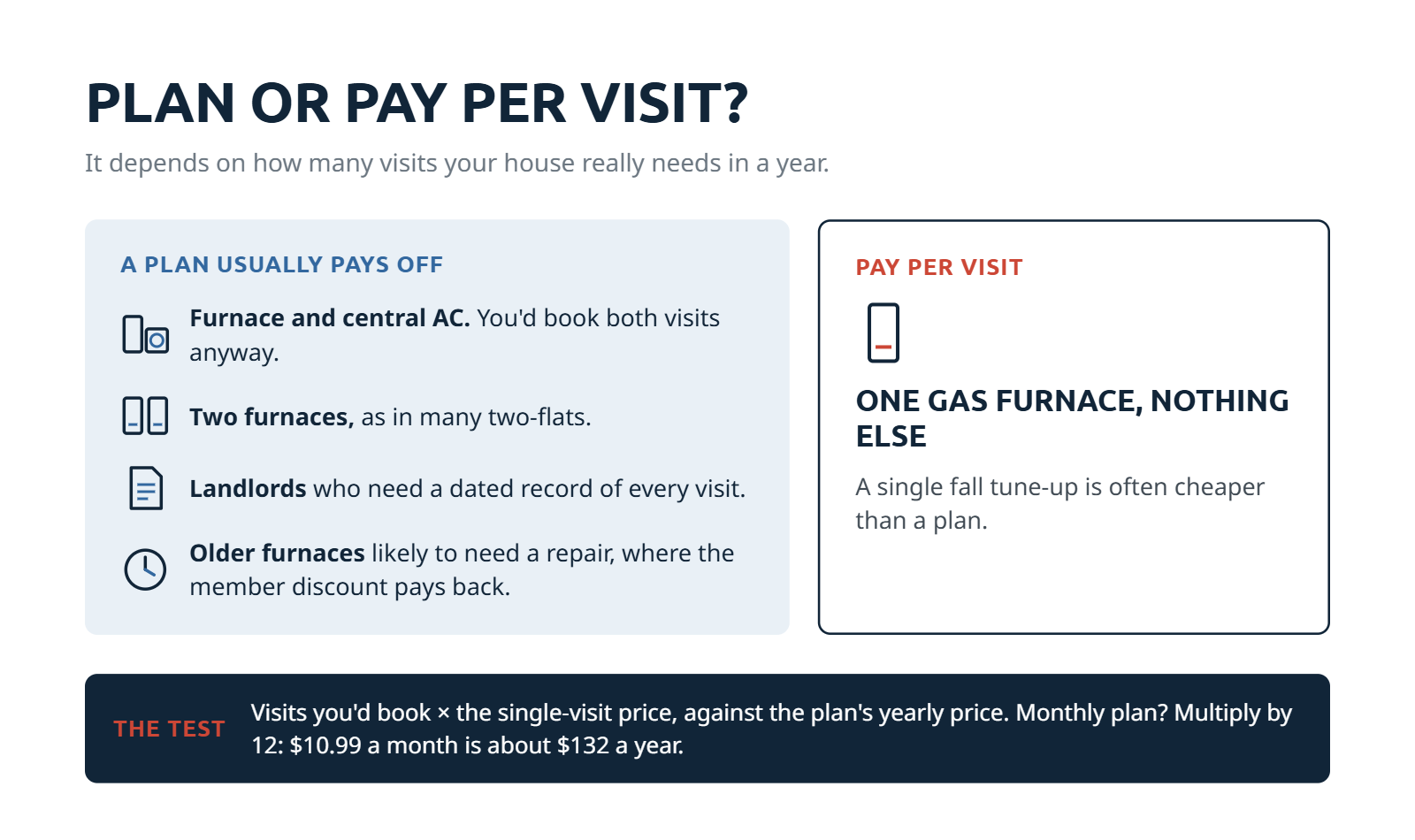
Chicago contractors list maintenance plans at $150 to $500 a year, or about $10 to $30 a month [8]. A plan usually saves money only when a household would book both a furnace and an AC visit, or has two furnaces. For one furnace and nothing else, a single fall tune-up often costs less.
💸 Do the math once
Add up the visits you’d really book in a year. Multiply by the single-visit price. Compare that with the plan’s yearly price, and add what the member discount would save on a typical repair. A monthly plan has to be multiplied by 12 first: $10.99 a month is about $132 a year.
| Price line | City & Suburban |
|---|---|
| Tune-up, one gas furnace | $149, standard 1-inch filter included |
| Maintenance plan, monthly | $15 a month |
| Maintenance plan, yearly | $179 a year |
| Plan member discount | 15% off repairs |
⭐ Who a plan suits
- Furnace and AC owners who’d book both visits anyway.
- Two-flat owners with two furnaces.
- Landlords who need a dated record of each visit.
- Owners of older furnaces likely to need a repair, where the member discount pays back.
⚠️ What to check in any plan
Ask what each visit covers, how many systems are included, and whether filters are. Check how it renews and how you cancel.
✅ Customers who stay on a plan
“I have been using City & Suburban (Rob) for 8yrs just for maintenance and he has been great every time. I trust no one else. …”
– Enrique G., June 2025, City & Suburban Google – Verified Review
City & Suburban’s HVAC maintenance plans include seasonal check-ups, priority dispatch, and 15% off repairs, for $15 a month or $179 a year. If you own one furnace and nothing else, I’ll tell you when a single visit is the cheaper route.
Q8: What happens if a furnace tune-up finds a problem?
A tune-up price doesn’t include repairs. The technician should show you the problem and give a written price. They should also say whether it’s a safety issue or something that can wait. City & Suburban credits its service call fee toward the repair and quotes the price before any work starts.
💸 What fall tune-ups usually turn up
The common finds are small. Think a dirty flame sensor (usually cleaned during the visit), a weak capacitor, a worn igniter, a clogged condensate drain, or a chimney vent problem. Repair prices vary widely. One aggregator puts the average Chicago furnace repair at $291, with most between $124 and $476 [7]. That figure comes from its own listings.
Our guide to furnace repair cost in Chicago lists each of those repairs part by part.
⚠️ If the technician shuts the furnace off
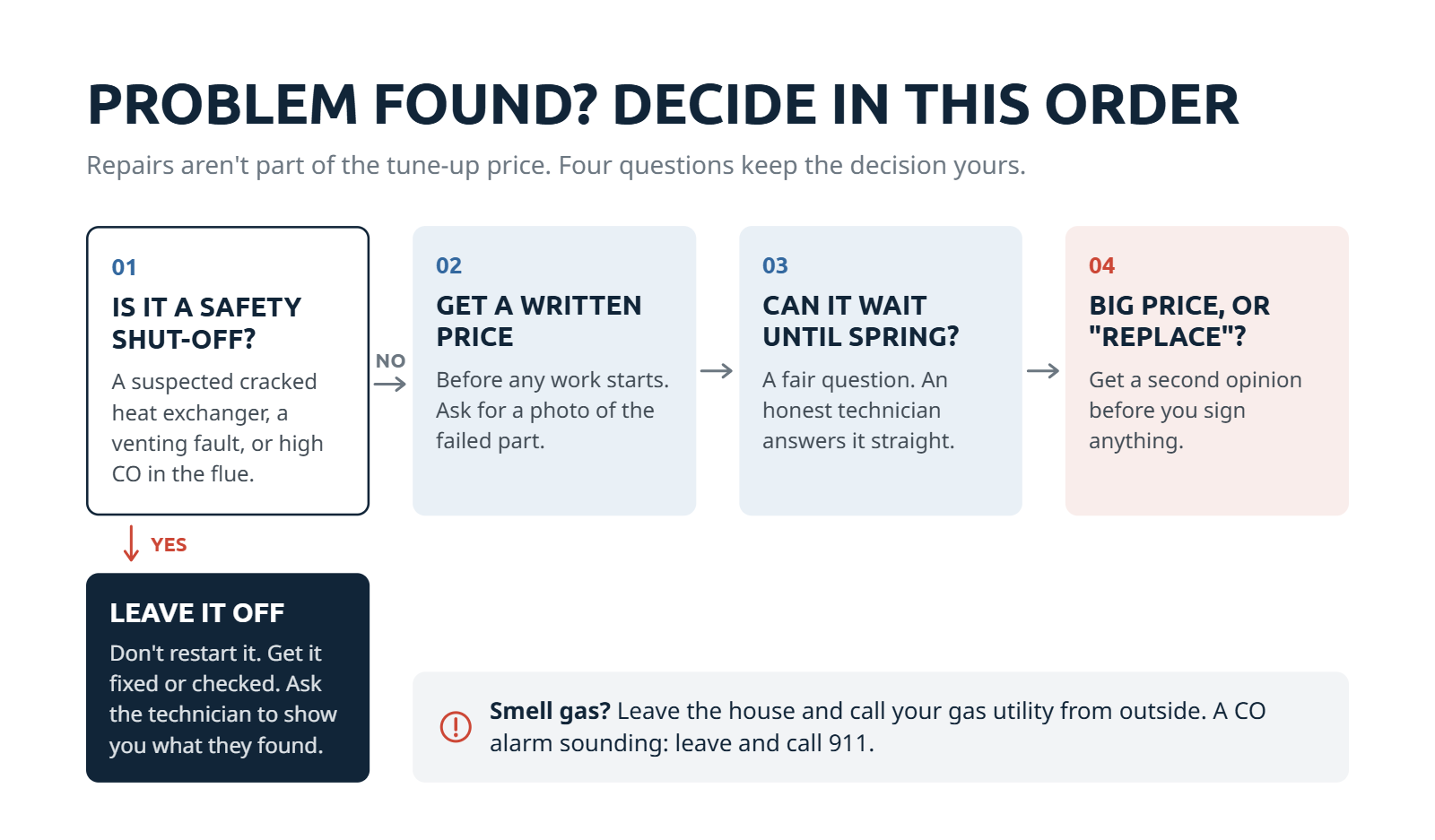
Sometimes a technician turns the furnace off for safety: a suspected cracked heat exchanger, a venting fault, or high carbon monoxide in the flue. They should explain why and show you what they found. Don’t restart it. You can ask for a second opinion before paying for a big repair or a new furnace.
✅ The decision, in order
- Is it a safety shut-off? If yes, leave it off and get it fixed or checked.
- If not, get a written price before any work starts.
- Ask whether it can wait until spring.
- If the price is large, or the word “replace” comes up, get a second opinion.
Two City & Suburban customers describe problems found and fixed without a replacement:
“Recently bought a new home and the furnace had been short cycling. Their sticker was on the furnace so I called them to come out and take a look. Turns out parts needed cleaning that stopped the short cycling issue. Furnace is nearing its useful life but not yet! Thanks Rob!”
– Jessica F., November 2025, City & Suburban Google – Verified Review
“I have dealt with City and Suburban since October 4, 2017, because it is highly dependable and efficient. Rob always comes out at a convenient time and his excellent service prevents problems from occurring. When I needed him recently to check my furnace due to water leaks related to a clogged condensation pipe above my condo unit he came out right away, and since he was already here, serviced my condenser unit outside as well. It saved a service call, and his charge was very reasonable. …”
– Larry V., July 2025, City & Suburban Google – Verified Review
⭐ Why a second opinion is worth a call
This City & Suburban review is about an air conditioner, not a furnace, but the pattern is the point:
“When another company purported that I needed to replace my central air conditioning unit, I called Rob from City and Suburban for a second opinion. He quickly diagnosed the problem as a minor leak that could be repaired quickly, and he restored the unit to life at a fraction of the cost that I would have otherwise paid. The air conditioner continued to operate for years, by the way. …”
– Mike T., May 2025, City & Suburban Google – Verified Review
City & Suburban’s owner does the diagnosis himself, and repair is attempted before replacement is quoted. For a big repair, City & Suburban’s furnace repair visit gives a written price first, with same-day service when the schedule allows.
Q9: What can you do yourself between furnace tune-ups?
Between tune-ups, you have five jobs. Check the filter monthly in winter, keep the furnace area clear, and clear snow from outside PVC vents. Test carbon monoxide alarms, and watch the condensate drain on a high-efficiency furnace. Leave the burners, gas valve, and heat exchanger to a technician. ENERGY STAR lists the filter as the homeowner’s own monthly job [1].
✅ Five jobs, and what “done” looks like
| Job | How often | Done when |
|---|---|---|
| Check or change the filter | Monthly in winter | The filter isn’t gray, and the size is written down |
| Keep the furnace area clear | Every few months | Nothing stored within a few feet of the furnace |
| Clear outside PVC vents | After every snowstorm | Both pipe ends are open and free of ice |
| Test CO alarms | Monthly | Alarms sound on test, on every level and outside bedrooms |
| Watch the condensate drain | Monthly in winter | No water pooling under a 90%+ furnace |
Our furnace filter guide covers sizes and how often to change each type.
⚠️ The Chicago snow job
High-efficiency furnaces pull air in and push exhaust out through two plastic pipes on the side of the house. After a heavy snow or a drift, those pipes can block, and the furnace shuts itself down to stay safe. Clearing them takes a minute and saves a service call.
The US Consumer Product Safety Commission advises carbon monoxide alarms on every level of the home and outside sleeping areas [2]. Illinois sets its own rules for home alarms in the Carbon Monoxide Alarm Detector Act [4]. Test your alarms when you check the filter, and swap the batteries when you change the clocks.
❌ What not to do yourself
Don’t open the burner compartment, adjust the gas valve, or run the furnace with the front panel off. Those jobs need instruments and training.
City & Suburban technicians will point out the filter slot and the condensate trap during the visit, so you know what to check next month. To book a furnace tune-up, call City & Suburban at (773) 238-3838, or use the Schedule Service form.
About the Author
Robert Koehler is the owner of City & Suburban Heating & Cooling, a family run heating and cooling company in Chicago. His father started the business in 1952, going door to door offering furnace cleaning across the city. Rob runs it today as the second generation.
He still performs service diagnostics himself rather than sending out a salesperson. That is how he ended up with the habit that shows up over and over in the company’s reviews: he repairs systems that other contractors have already quoted for full replacement.
City & Suburban serves Chicago and the near north and northwest suburbs. The company holds a 4.98 average on Google across 204 reviews and 4.9 on Yelp across 251 reviews. It is an American Standard dealer, and its technicians are NATE certified. Read more about City & Suburban.
You can reach Rob directly at (773) 238-3838.
References
- ENERGY STAR (US EPA and DOE), “Maintenance Checklist,” accessed 12 November 2026. energystar.gov
- US Consumer Product Safety Commission, “Carbon Monoxide Information Center,” accessed 12 November 2026. cpsc.gov
- City of Chicago Department of Buildings, Heat Ordinance, Municipal Code 13-196-410. chicago.gov
- Illinois General Assembly, Carbon Monoxide Alarm Detector Act, 430 ILCS 135. law.justia.com
- City & Suburban Heating & Cooling, Google Business Profile reviews, 2023 to 2026 (each review linked in the text).
- r/hvacadvice, “Are furnace tune-ups worth it? Or if the furnace is working fine,” Reddit thread. reddit.com
- Angi, “How Much Does Furnace Repair Cost in Chicago, IL?” angi.com
- Four Seasons Heating, Air Conditioning, Plumbing & Electric, “Furnace Tune-Up Cost in Chicago: 2026 Data,” accessed 12 November 2026. fourseasonsheatingcooling.com
- ABC Plumbing, Sewer, Heating, Cooling & Electric, “$49 Ultimate Furnace Tune Up” offer. 4abc.com
- Pro Comfort Solutions, “Furnace Maintenance & Tune-Up in Chicagoland.” procomfortsolutions.com
- Polar Heating & Air Conditioning, “Furnace Maintenance Price: Costs & Coverage Explained” (2019). polarheatingandair.com
- Trilogy AC, “The Cost of Furnace Maintenance Service,” accessed 12 November 2026. trilogyac.com
- American Standard Heating & Air Conditioning (Trane U.S., Inc.), “Warranty and Registration” and furnace Base Limited Warranty GW-FURN-2401A, accessed 13 November 2026. americanstandardair.com
FAQs
A furnace tune-up on one gas furnace usually takes 60 to 90 minutes. That is the range Google's own answer gives, and it matches the times Chicago contractors publish with their offers. A first visit to a house, or a home with two furnaces, takes longer.
Here is roughly where the time goes:
- Start-up and filter: we check the thermostat call for heat and the filter size.
- Cleaning: burners, igniter, and flame sensor.
- Measuring: gas pressure, combustion and carbon monoxide in the flue, temperature rise, and static pressure.
- Safety: limit switches, venting, the condensate drain on a 90%+ furnace, and the carbon monoxide alarm.
A visit that finishes in 20 minutes has usually skipped the measuring, which is the part you are paying for. City & Suburban's technicians write all five readings on a tune-up sheet every time, so you can see what the time was spent on.
If you want a fall slot, our heating maintenance page has the details, and the best weeks to book are September and early October.
No. Cleaning is one part of a tune-up, but a tune-up also measures how the furnace is running and tests its safety controls. Google's answer lists stand-alone furnace cleaning separately, at about $50 to $300 depending on the system.
The difference matters because of what you learn:
- A cleaning removes dust from the burners, flame sensor, and blower. The furnace often runs better afterward.
- A tune-up adds the numbers: gas pressure, carbon monoxide in the flue, temperature rise, and static pressure. It also checks the limit switches, the venting, and the condensate drain.
A cleaning can't tell you whether the furnace is burning cleanly or venting safely. Only the measurements can. That is why we'd rather do the full visit once a year than a cleaning twice.
City & Suburban began in 1952 with Rob's father going door to door offering furnace cleaning in Chicago, so we know the cleaning side well. Today our technicians pair it with the readings: gas pressure, flue carbon monoxide, temperature rise, static pressure, and the flame signal go on the tune-up sheet every time. You can read how we approach heating maintenance in Chicago before you book.
The $5,000 rule is a rule of thumb for repair-or-replace decisions. Multiply the furnace's age in years by the repair price. If the result is over $5,000, get a replacement quote before you pay for the repair.
Two quick examples:
- A 10-year-old furnace with a $300 repair scores 3,000. Repair it.
- A 20-year-old furnace with a $400 repair scores 8,000. Get a replacement quote first.
It's a starting point, not a verdict. The rule ignores how well the furnace was kept, whether parts are still made, and whether the repair fixes the real problem. A well-kept older furnace can be worth repairing, and a young one with a cracked heat exchanger may not be.
City & Suburban's owner does the diagnosis himself, and repair is attempted before replacement is quoted. If a tune-up turns up a large repair, we give a written price first. When the numbers point to replacement, we say so plainly, and we explain why. Our heating repair page explains how we handle those visits, and a second opinion is always a fair request.
Yes. A new gas furnace should get a tune-up once a year from its first heating season. New equipment still needs its gas pressure, combustion, and airflow checked, and the first year is when installation problems show up.
There are two practical reasons:
- The baseline: the first year's readings become the numbers every later visit is compared with. A change from that baseline is often the earliest sign of a problem.
- The warranty: many manufacturer warranties expect documented yearly maintenance. Rules differ by brand, so read your own paperwork and keep each year's tune-up sheet with it.
If your installer included a first-year check, use it, and book your own visit the following fall. If not, book the first one before the second winter.
City & Suburban is an American Standard dealer, and we install and service new furnaces across Chicago and the near north and northwest suburbs. American Standard's furnace warranty requires maintenance by a licensed HVAC service provider following the maker's instructions, and the company may ask for written proof of preventive maintenance (checked November 2026, American Standard warranty). We register the manufacturer warranty on every furnace we install. If you're still choosing equipment, our heating installation page covers what we check before we quote.
Yes. A boiler with radiators needs a yearly service as well, but it's a different visit from a furnace tune-up, with different checks and a different price.
Many Chicago bungalows, two-flats, and greystones still heat with steam or hot-water boilers. A boiler service usually covers:
- The burner, combustion, and carbon monoxide in the flue, as with a furnace.
- The water side: pressure and level on a hot-water system, or the sight glass and low-water cutoff on a steam system.
- Venting and the chimney connection, which matter in older buildings.
- Radiators that heat unevenly, which can point to air in the system or a balancing problem.
Book it in the fall, the same window as a furnace. Landlords who supply heat should have it checked before September 15, when the Chicago Heat Ordinance starts.
City & Suburban works on steam and hot-water boilers in pre-war Chicago housing, including systems retrofitted several times over a century. Our boiler service page explains what that visit includes.